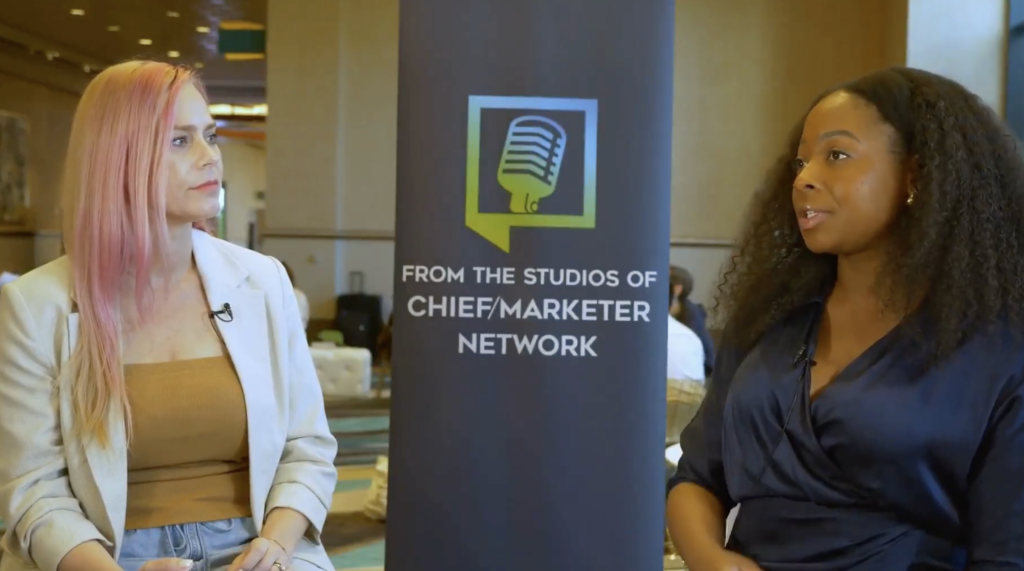
At the Experiential Marketing Summit last month, Chief Marketer Associate Publisher Kaylee Hultgren sat down with Lauren Flanigan, Head of Global Brands, Refreshment Categories at Mondelez International, to discuss how her brands use experiential as a channel to support the overall marketing mix, her thoughts on event measurement, marketing a brand globally while maintaining local relevance and more.
Transcript:
Kaylee Hultgren:
Hello everyone. I’m Kaylee Hultgren, Content Director for Chief Marketer, sister publication of Event Marketer, which is putting on the Experiential Marketing Summit. That’s where we are today in Las Vegas. I’d like to welcome Lauren Flanigan, who is head of Global Brands, Refreshment Category at Mondelez International. Welcome, Lauren.
So since we’re at the Experiential Marketing Summit, let’s start by talking a little bit about what, how your brand uses event marketing and experiential as a channel.
Lauren Flanigan:
Yeah, great question. Well, we do very much consider it a channel, just like any other media tactic. So we think about the full ecosystem and the message that we wanna land for the year or the big objectives for the brand. And then it’s all about finding the right tentpoles to activate and finding the right events within particular passion points that we’re trying to further with groups that we wanna grow with.
Kaylee Hultgren:
You are going to be on a panel a little bit later, which I’m moderating. Could you talk a little bit about what you’re gonna discuss on the panel and what you want attendees to come away with?
Lauren Flanigan:
Awesome. Yes. Well, our panel is from moments to movements, and it’s all about taking the experience beyond just the event. So how do you build that narrative over a longer time? How do you really extend the experience of an event to get to a stronger return? So what I hope the audience will take away is that one, it starts with authenticity. Not every brand needs to show up at every moment. It’s really about finding the right event that your brand uniquely can speak to. And then it’s about showing up consistently. So not just a one-off at a particular event, but if you’re trying to build a community around a particular passion point, how do you keep the conversation going beyond just the particular physical event?
Kaylee Hultgren:
Mm-hmm <affirmative>. So looking forward to the conversation later. It’s very challenging today with all the noise happening. So I’m excited to talk about that later. Mondelez as a portfolio has a lot of iconic snack brands, that people have emotional connections with from childhood. So how does that existing brand love shape how you’re creating experiences? And are you amplifying something that’s already there or are you trying to create something new?
Lauren Flanigan:
Great question. And it’s honestly a little bit of both. It can be both a help and a challenge when you have this long history and you have brands that have been known for nostalgia. A lot of the Mondelez brands are hundreds of years old. If you can believe it. So that’s a help in the sense that you do have some existing brand love, but it becomes really important to modernize that, to stay relevant, to keep current.
And so a brand like Oreo, which I was really privileged to work on across many different roles, is a brand that’s a hundred plus years old and does have the nostalgia. It’s rooted in family. But when I was working on the brand, we were at a moment where we wanted to take it beyond just family. So in an instance like that, how do you find new relevance with new groups? And we actually used experiential and events to do that. We launched an Oreo Cafe in New Jersey at a really exciting partnership that we had with one of our licensing agreements. But it’s a really great example of using events to extend events and experiential to really extend the ubiquity of a brand and to be able to make new connections and new relevance.
Kaylee Hultgren:
So what is, what is the difference in practice between a brand moment that fades and one that becomes a movement? Is there a formula to make sure it becomes a movement?
Lauren Flanigan:
Great question as well. And I think, again, it starts with authenticity. So finding the right moment for your brand to show up where it makes sense and you’re telling a story that only that brand can tell. And there’s an element of continuity that I think takes it from just a moment to a movement. And some good examples that I’ll be able to speak to on the panel later are Trident. So one of the brands that I work with in the global capacity that I’m, leading refreshment categories now, Trident is a really culturally relevant brand in Latin America in particular. And two of the groups that we really like to speak to are Gen Z in particular, but really finding the passion points within it are folks who are music fans and gamers.
And so with that brand, what we do is we continue to show up in those passion points over time. So in Brazil it might be sponsoring an activation at Carnival or Rock in Rio. In Mexico we actually sponsor a stadium that’s a gaming eSports stadium. So it’s about finding those passion points, but looking at ways that you can engage with continuity, not just a one-off, but showing up in an event, having the digital relationship, building the creator network around it as well. So I think it starts with continuity and really the authentic narrative your brand tells.
Kaylee Hultgren:
Talking about creator culture, it has really changed the way that you get to tell a brand story. So how do you balance handing the narrative over to the creator with making, still making sure that you have that authenticity of the brand and that it’s the story that you wanna tell at the same time?
Lauren Flanigan:
Yeah, absolutely. It starts with trust and a really clear point of view that you’re trying to tell with the brand. So in order to really get to something special, you do have to really put it into the hands of the creator and let them do their thing. They know their voice, they know their audience, you really have to give up a little bit of the control to be able to really execute it well. But I think when it’s done well, it’s starting with the right partner that aligns with the narrative and the values of your brand naturally, authentically, organically anyway. And then you are able to build that trust because you’re both speaking from a place of authenticity. So I think it all starts with trust, finding the right creators that have the same values that are sharing the same type of message that you wanna share as a brand.
Kaylee Hultgren:
So there’s a tension between brands that show up at cultural moments authentically, and those that just show up. So how do you know the difference and how do you make sure that Mondelez brands are on the right side of that?
Lauren Flanigan:
Yes, I love that question. And I think the biggest thing when I am thinking of that question, it’s really that brands don’t need to do everything. So you see a lot of instances where there’s these big moments in culture and every brand feels the need to jump on it and be a part of it. But I don’t think it’s about the number of events or even sometimes the size or eyeballs of events. It’s like, what is the moment that your brand can uniquely speak to? Like what’s the point of view that you’re trying to bring in the conversation and why is your brand in it? I think is the first piece is when that really does work well or doesn’t.
Kaylee Hultgren:
Fan driven storytelling can go in directions that you didn’t anticipate. So can you share an example where something unexpected happened and what you learned from it?
Lauren Flanigan:
Thankfully, I don’t have an example of that to date, but when I look in culture and I see this happening, I think it’s one, if a brand doesn’t have really crystal clear clarity on what their strategy is, like what is the one line that you’re trying to communicate with whatever campaign or event or activation you’re doing. And if that isn’t crystal clear, it’s very easy for it to get muddied in conversations. And fans, whether Ill intended or positive intended, can take things and run with it if you’re not showing up with a lot of clarity. So I think that’s one common thread is when there’s a lack of really simple clarity of what you’re trying to communicate, things get muddied very quickly. And then I think again, coming back to the point of authenticity, when brands aren’t showing up in a way that’s true to their values, true to the product, then it’s easy for that message to get diluted as well.
Kaylee Hultgren:
So the pressure to produce real time content at events is, is real. How do you staff and structure for that and how do you avoid sacrificing quality for speed?
Lauren Flanigan:
It’s a great question and it’s actually, I think when this works well, it becomes such a value-add to the experience, both for consumers and for brands. You’re able to get so much more content, so much more longevity out of a moment. So when done well, it’s a really powerful unlock. When I think about how to do this, I think about one of the most successful activations we had on Trident years ago was 2019, and we did a pop-up takeover with T-Pain, which was super fun.
We did it in Chicago and a big part of the activation was because we were actually launching a new social channel. And so it was kind of our moment to do exactly that. So I think what worked really well in that situation was we actually had our organic team with us there on the ground. They were taking live content, live footage of everything, and we were lockstep hand in hand, standing by each other thinking about this is a good moment to get, this is another one. And doing real-time approvals. So I think it works well when there’s that partnership when you can get the right team on the ground together and be there side by side, making those decisions live. And in the moment, I think you get a good balance of that alignment so that you have quality pieces that you can put out in real time.
Kaylee Hultgren:
Platforms change constantly. What works on TikTok today might not work in 18 months. So how do you build a digital marketing strategy that isn’t too reliant on one particular platform?
Lauren Flanigan:
Great question also, and I would say that it starts with really looking holistically. So starting with taking the step back and thinking about what’s the brand message and then what is the specific unlock that each digital platform can bring. So what I would want to communicate about one of my brands on TikTok isn’t gonna be the same as what I want on Instagram or on X, et cetera. So I think it’s first, what’s the brand message I want to land? What platform specifically can help with that piece of the message. And then you don’t necessarily need to pivot if that platform moves as relevance, if you’ve already had it planned what the message will be on other places as well.
Kaylee Hultgren:
When you’re thinking about measurement, how do you make sure that you provide some sort of ROI and proof, without just relying on impressions? Because people don’t really, especially the C-Suite, they don’t care about impressions anymore.
Lauren Flanigan:
Yes. It’s true and it’s real. And I think we have to be honest, I don’t think we’ve fully cracked how to measure ROI of events and activations. I think there are things like you’re saying impressions or attendance or number of samples given out, or number of signups on email that help tell the story. But in reality it’s not a simple thing to directly measure. So when I think about ROI, I really start with what’s the business objective from the beginning? And where did these things play a role? So for example, if I am making up numbers, if I wanna grow a brand, a billion dollars, if I need to do that by penetration, then that’s one part of the strategy.
If I need to do that via reach, that’s a different part of frequency. So in thinking about penetration as the example, if I know I need to penetrate a particular group, what do they care about? And how do I design a full narrative of the ROI of growing with that particular group? And why these passion points, why these events and activations matter for that overall narrative. So I think it’s actually starting at a level higher. Instead of looking at the ROI of a particular specific event, it’s thinking about how does it tell the story of the overarching business objective?
Kaylee Hultgren:
So a little bit about your overall marketing strategy. Global brands have to operate in very different cultural contexts. So how do you build an experiential framework for Mondelez that is consistent enough to scale, but also keeping it local at the same time?
Lauren Flanigan:
Yes. And the local nuance is so important and it is always that tension of getting the benefit of leveraging scale, being able to share cost, being able to really build assets that can work across cultures is a huge unlock when it works. But local nuance is really important. I can visit Brazil every week and still not have the same perspective as that local market. So, for me it’s about finding that right balance and experiential is one of those. And it starts with thinking about what’s the 360 kind of ecosystem that I want to build for this brand? What are the passion points that speak to that ecosystem? And what are the local specific cultural things that help amplify that moment? So I mentioned Rock in Rio and Carnival in Brazil earlier. That’s a great example of local executions of a global vision of really activating music as a passion point.
Kaylee Hultgren:
A couple more questions for you. Snacking is a category that touches everyday life. It’s not a luxury, not really aspirational. So how do you make emotional brand building? Is that harder or easier for the brands that you work with? How do you make it something that is more seamless and really affects people? Yeah, great question. And I think the brands that have stood the test of time, like an Oreo, like a Trident like these long, like a Cadbury, these long story brands have found that balance. Otherwise you’re just a private label product. You’re not a brand at that point. And I think that it’s necessary to have the emotional equity communications and these really iconic brands, even if we don’t necessarily always see them on the surface, do that work of, what is the one word emotional payoff that I want consumers to have?
So for Oreo for years it was, playfulness. For Cadbury, it was about generosity. If you think about Disney for example, I believe their word is magic. So it’s what is, even if it’s something that I am physically ingesting and it’s a product, at the end of the day, there has to be some kind of emotional value given back for the consumer to be able to experience. So I think it’s necessary and it’s really the way that brands stand the test of time is by finding that emotional connection first.
Kaylee Hultgren:
There’s a lot of conversation in marketing right now about the pendulum swinging between brand and performance. Where do you think the balance is and how is Mondelez looking at that?
Lauren Flanigan:
Great question and extremely relevant now. I think there’s some fears that things like agentic AI that will eventually do all of our shopping for us will make it really important to have performance. But I actually argue that it’s the opposite. And so I’ve been lucky enough to work across full funnel media in my career. So I’ve led direct to consumer on Oreo and Sour Patch Kids, and we had tons of conversion metrics, a lot of performance media. But also in these traditional brand management roles, your bigger higher funnel awareness metrics are more important as well. And I think when I think about things like AI, when I think about things becoming increasingly digital, I want for my brands to be in the position where consumers aren’t asking ‘buy me cookies.’ They’re asking buy me Oreo. And the way that you do that is by building that emotional connection. By having that relevance, by having bigger equity, focused communications and brand plans.
Kaylee Hultgren:
Let’s talk a little bit about AI. It’s reshaping everything from creative to production, advertising, audience targeting. Where are you seeing it work within Mondelez and where, are you still skeptical, if so?
Lauren Flanigan:
Interesting question. I would say that we are at a really interesting time with AI. I don’t think we’re in a place where AI is at the level of craft that I think it still has the potential to get to. And I do think that it’s important to find the balance of like, where’s the human craft and creativity versus where’s the efficiency that we can glean from AI. And I think that that’s still to be defined for me. I definitely think that AI is useful. I definitely use it in my personal life, use it in my professional life for simple things like being able to synthesize notes to being able to generate ideas and really kind of use it as a thought partner. So I think that AI is still evolving. What my hope for it is, is that we see it as efficiency and not a replacement for creativity.
Kaylee Hultgren:
So you’re operating at a global level across multiple brand categories. How do you keep your teams genuinely curious and close to culture, given the organizational scale at a company like Mondelez?
Lauren Flanigan:
Yes. Well, I’m really fortunate. I have an incredible team. I work with really amazing people that are really hungry and smart and curious on their own. But I do try to lead by example as well. So I want in our status meetings or in our one-on-ones to bring up a couple of things that are on my mind in culture or to share articles with the team or it’s great that I’m here this week as well to be able to see what’s coming next in events and experiential. And this is definitely something I plan to take back to my team and share what I’ve seen and where I think we could step up. So I think one, it’s just being fortunate to have great talent and being an organization that attracts that, but it’s also leading by example and sharing with the team and encouraging that as a behavior.
Kaylee Hultgren:
So a little future casting here. What do you think the marketing industry is going to look like in five years? Predict what we might lose and what we might gain.
Lauren Flanigan:
Interesting. In five years, I expect that there will be even more consumer choice in five years than we have today. I think we’ve already started to see that, where there’s so many brands that are able to spring up almost overnight it seems, and be able to make really meaningful impact in culture to drive really meaningful sales as well. So I think consumer choice will continue to grow and I think it puts the burden on historic, heritage brands to keep up and to continue to be innovative, to be able to maintain those relationships with their consumers as well.
The other thing that I anticipate will change is the control that brands have over their narrative. So thinking about your earlier question around fandom, around creators … There’s an increased share of voice that’s coming from not the brand. And so I think it’s even more important to really have a crystal clear strategy of what your message is as a brand, crystal clear on your authenticity and really thinking about your reputation as a brand and how you manage that over time.
Kaylee Hultgren:
Last question. What do you think is over-hyped in marketing and what’s one thing that’s under-hyped.
Lauren Flanigan:
That is hard. I think my broad answer: over-hyped is short term gain and ROI. It’s important at the end of the day, we all have to drive the business. You have to win today to win tomorrow. But I do think that can sometimes come at a trade-off of the longer term wins as well. And sometimes we as business leaders, as marketers can be impatient and wanting to see success overnight, but we have to be careful to not let that remove the opportunity for the longer term wins. The things that don’t show as quickly; the things that are a little bit more intangible. So that would be what comes to mind for me is the balance of short and long term.
Kaylee Hultgren:
Excellent. Well, thank you so much, Lauren. Really appreciate you coming out and chatting with us today. I know you’re really busy and we appreciate your perspective.
Lauren Flanigan:
Awesome. Thank you Kaylee. Good to be here.