Candy brand Hi-Chew has doubled its brand awareness in the U.S. since 2018, but it wants more Gen Z customers as the group increases its spending power.
Hi-Chew may be 50 years old, but the Japanese candy brand still has work to do to increase its brand awareness with U.S. consumers, said Joanne Hsu, Senior Brand Marketing Manager at Morinaga America Inc., which owns Hi-Chew.
The brand is tapping into in-person activations with sampling to get its product in front of new audiences, and specifically, Gen Z consumers.
Hsu estimates that roughly a third of its customer are Gen Z, a third are Millennials and the remaining third are Gen X or older. This is a good mix for now, Hsu said, and makes sense given that Hi-Chew has previously focused its marketing on Gen X and Millennials, as those age demographics have been the primary household candy purchasers, she said. The goal now is to grow its share of Gen Z customers. Plus, the brand wants to begin increasing awareness with Gen Alphas, which are consumers 14 years old and younger.
“Seeing that Gen Z will becoming the next generation who has the buying power, we started earlier in the process two, three years ago, we started to shift our strategy toward a younger demo — specifically for Gen Z,” Hsu said. “That helped to shape the marketing strategies down the line over the past three years and onward.”
Hi-Chew Samples its Getaway Mix at Miami Airport
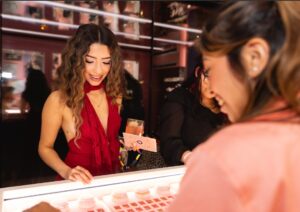
In March, for example, Hi-Chew hosted a pop-up at the Miami International Airport to launch its new flavor mix of product the “Getaway Mix.” Many consumers take vacations during spring break, including Gen Z consumers, and the goal was to get consumers to stop and try the product.
“Sampling is essential because we have a lot of new, innovative and unconventional flavors that people cannot find in any other candy brands,” Hsu said. “So sampling is a very key driver for the consumer to explore the brand.”
The Getaway Mix includes the flavors of Mango Chamoy, Mai Tai and Yuzu Lime. Over the 11 day pop-up, 36,000 consumers visited the booth and Hi-Chew distributed 48,000 samples. Plus, from an influencer program, Hi-Chew generated more than 132,000 impressions and 1,500 engagements on social media related to the activation. Larger activations cost more than $100,000 to put on, Hsu said.
During an activation, Hi-Chew listened to feedback on its flavors to guide future product and mix decisions. The brand tracks sales after an event, but that is not the key goal. The top priority of the activation is to increase brand awareness, Hsu said.
Brand Awareness Results
Hi-Chew conducts a brand lift study every August to evaluate its brand health, she said. It receives the results in October.
Brand awareness in 2025 reached 62% for the U.S. market, which is double what it was in 2018 when awareness was at 31%, Hsu said. This increase in brand awareness is “phenomenal progress.” What’s more, purchase intent increased two percentage points to 24% purchase intent in 2025 compared with 22% in 2024.
“While you might think two percentage points is minimal, but if you benchmark with other competitive sets, they have pretty flat purchase intent versus the year before or just plus one or minus one percentage point,” she said. “So a two percentage point growth for the Hi-Chew brand is pretty significant.”
Another key benchmark for Hi-Chew is the demographics of the brand awareness study. The brand’s marketing initiatives targeting younger consumers appear to be working, as 2025 Hi-Chew brand awareness of males ages 18-24 is 72%, up from 64% in 2024. For females, Hi-Chew’s brand awareness is 79%, up from 76% in 2024. In fact, Gen Z now has the highest brand awareness among the age groups, whereas Millennials and Gen X used to have the highest brand awareness, she said.
Other in-real-life activations
Hi-Chew hosted a handful of “in-real-life” activations in 2025. Beyond the airport pop-up, it had a presence at the musical festival Coachella and regularly distributed samples at Major League Baseball games. Not exactly real life, but Hi-Chew also has an on-going partnership with online gaming platform Fortnite, such as having Hi-Chew branded minigames.
“Our strategy is to show the brand where the audience is spending their time,” she said. “We wanted to show up authentically, naturally, not in forced way.”
While Gen Z is a focus, Hi-Chew still has marketing initiatives targeting Millennial consumers. One example is during Halloween 2025, it hosted a pop-up at California shopping mall Irvine Spectrum Center targeting Millennial parents with kids. Hi-Chew unveiled a new Halloween Mix of flavors, which it hadn’t updated since 2018. The brand hosted a guessing contest of what the flavor was at the pop-up and online. About 500 consumers attended the three-day pop-up and Hi-Chew distributed 45,00 samples. An influencer program drove 263,000 engagements on social media.
What’s more, the Halloween Mix product did better than expected, Hsu said, and the brand sold out before Halloween.
Hi-Chew’s Plans for 2026
These in-person activations that target current customers help deepen engagement with Hi-Chew fans, which it calls “Chew Crew.” Hi-Chew also sells apparel and limited edition merchandise to further excite its fans. Often its consumers will show up to an in-person event wearing the merchandise.
“People love that and that’s really important for us to keep the conversation going and then keep the fandom engagement through the merchandise that people are obsessed with,” Hsu said.
For 2026, Hi-Chew is revamping its packaging to be more visually appealing to Gen Z shoppers. It started this year with two of its core products, the Original Mix and Tropical Mix. While all generations care about how the products look, packaging influences Gen Z shoppers the most, Hsu said. These consumers are digital natives and heavy social media users, meaning they are accustomed to visuals capturing their attention quickly with a message, she said.