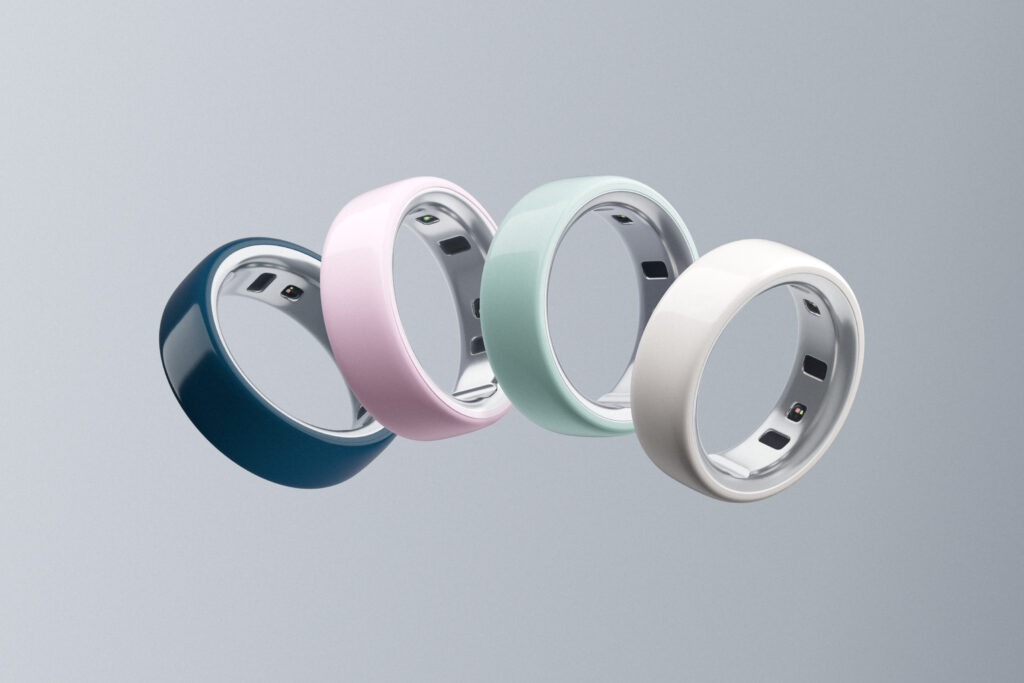
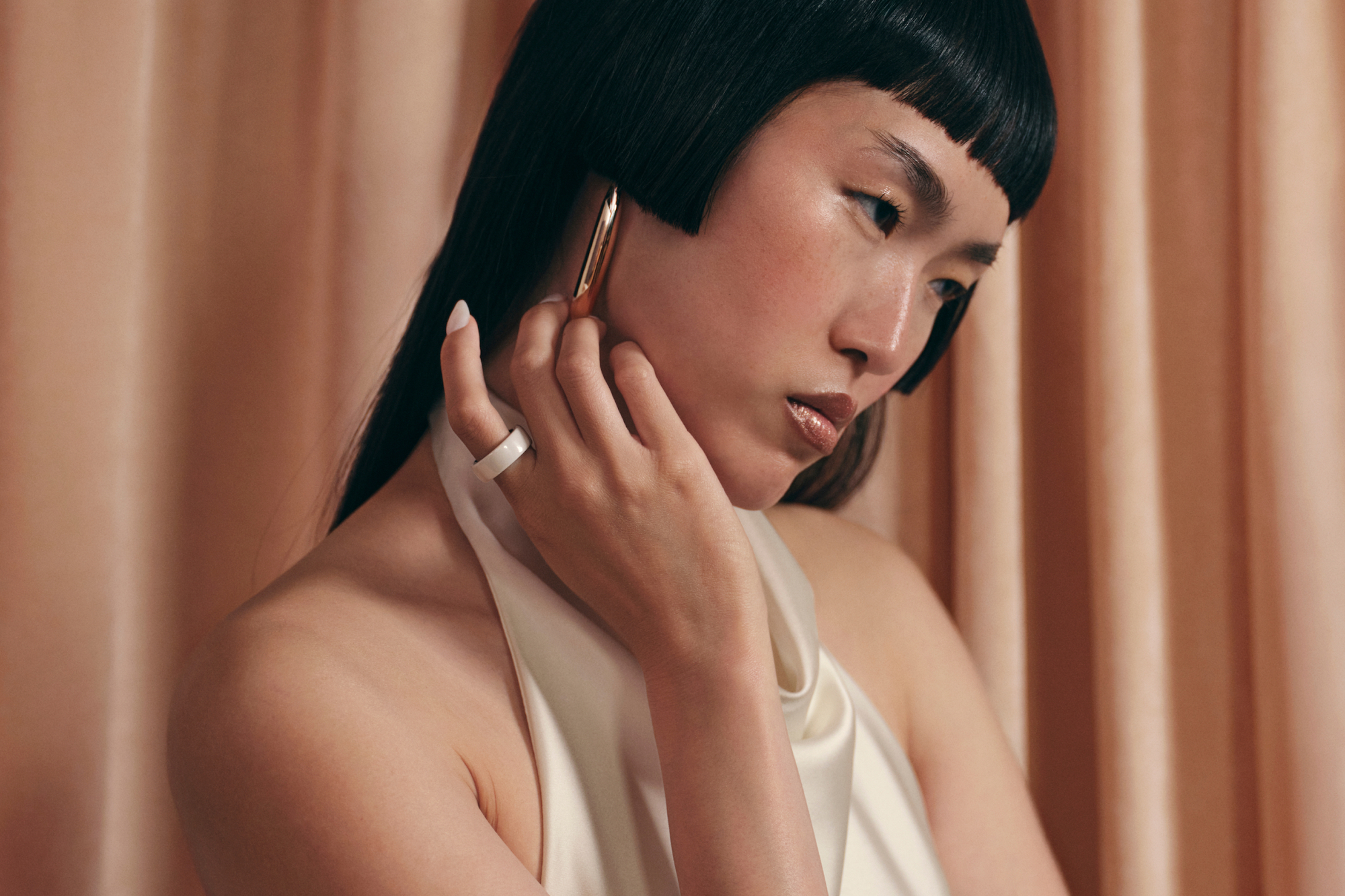
Oura has positioned its latest smart ring collection, the Oura Ring 4 Ceramic, as a powerful health and wellness device— that also passes as a fashion accessory.
According to CMO Doug Sweeny, you can thank consumers for the new look. The brand is in constant dialogue with them, and the feedback prompted some of the ring’s latest upgrades.
For one, a more durable, scratch-proof material was requested, inspiring Oura’s design team in Finland to develop its own formulation of zirconia ceramic. People also asked for multiple colors — beyond traditional metals — as well as the ability to mix and match the rings with different outfits. The result was a more fashion-forward device that warranted a campaign focused as much on style as technical capability.
“We’ve had a strategy of tech that blends in or disappears, and this was very much about tech that stands out,” Sweeny said. “That a healthcare product could actually be pretty cool and could play into fashion is a different idea. It’s not something that’s common, and we thought that was real powerful as a jumping off point.”
The product offers four new colors — Tide, Cloud, Petal and Midnight — that feature heavily in the Gen Z- and millennial-focused marketing campaign, from 15- to 20-second lifestyle vignettes to urban OOH ads to an AR try-on lens on Snapchat. In addition to the new style features, the device offers health panels, which allow users to schedule bloodwork directly in the Oura app and monitor 50 cardiometabolic markers.
We spoke with Sweeny about the marketing campaign, retail components, health and wellness partnerships, and the strategy that led to Oura’s recent uptick in sales.
CM: What were your strategic marketing goals with the campaign? Is this a large brand awareness play across the globe?
DS: It’s the biggest campaign we’ve launched to date in scale. A year ago we were not as globalized as we are today, but we have more global reach and more retailers and partners than we did then. I run a large part of our revenue on retail and D-to-C, so revenue is important, obviously. But we’re looking for innovation and engagement within the brand. We want to meet members where they are. There’s a constant feedback loop with consumers about this; we’re constantly talking to them about what they’re looking for and what they like, and then we’re ideating off that.
CM: The target for this is Gen Z and millennials. How are you reaching them?
DS: On social, we’re leaning in harder to TikTok and Snapchat. Snapchat we’ve never really done before. We’re doing a virtual try-on lens where you can sample colors in the app and choose your color. We have a craft film that we designed. We’re showing up in live sports — streaming, mobile, linear. We’re showing up in urban environments — Los Angeles, New York City, London, Berlin, New York. We’re in Brooklyn. We’re in Helsinki. And the messaging is designed specifically for a younger audience. With TikTok, there’s been a lot of organic support within women’s health specifically, but a more concentrated effort of working with influencers and getting product to them and having them talk about the colors, ceramic and what it means to them.
CM: Beyond the vignettes, OOH and social media, another way you’re marketing the product is through retail co-marketing. How does that play out?
DS: We have a select group of retailers that are selling the ceramic. In the U.S., [it’s] Amazon, Target, Best Buy. And that’s at a store level. So if you go into a Target or Best Buy, you’re going to see the full range of products. You’re going to see everything: you can get sized, you can try on different colorways and see what you like — metal or ceramic — and buy right there, or buy digitally. In Europe, John Lewis is our selected strategic partner; in Germany, it’s MediaMarkt. And Amazon is our partner globally.
We have almost 40 retailers around the world that we’re working with. And not all of those are going to get this specific product, so we’re really [leaning on] our strategic partners. Within Best Buy specifically, we’ve been exclusive with them on the Midnight color in the U.S. And we’re selling all four colors on our direct-to-consumer channel as well.
CM: How did the partnership with Quest Diagnostics on the health panels come about? Is that for a specific customer?
DS: Other diagnostic tools partnering with Oura is something we’ve been focused on for a while. The metabolic [panel] is a good example of that: CGM [continuous glucose monitoring] [through our partnership] with Dexcom. We continue to see a shift where consumers are looking for more and more health diagnostics that can be integrated within the app very simply. So how does using metabolic — the food I eat and my glucose levels — how do they react to my activity, my stress levels and my sleep?
With health panels it’s the same. You can book an appointment at Quest, from 2,000 locations around the U.S., get your panel, and it’ll be fed automatically into the app. And you can use our AI advisor to ask questions about different levels. [Such as,] why is my cholesterol level at this level? Should I be concerned about that?
To your question about who uses it, it is definitely an early adopter product. It’s a type of consumer who wants to try different things to see how they can improve their health. There are people who use the CGM because they have pre-diabetes or they’re diabetic, and then there’s another group of people who want to learn about the way they interact with food and the rest of their health. That can be informative.
CM: Sales were extremely strong the past year — more than 2.5 million rings sold since June 2024. What marketing strategy or branding helped that along?
DS: One, we adjusted the positioning in a big way. We rebooted it. There was a lack of clarity internally on what Oura stood for and where we were going. That impacts our product roadmap and impacts our marketing. So we had a concerted effort to get that sorted out and market it internally, and then figure out how we can market it to the world. That’s one piece.
We opened up distribution channels around the world. I’ve been at the company three years. Prior to ’22, we had a commercial business and we were primarily a direct-to-consumer product sold on ouraring.com. We have 40 retailers around the world and some of the biggest in the U.S. and the EU, and we’re expanding in Asia Pacific. Being able to educate people on how to size, how to try in-store, and educate them [about] a jewelry-oriented product — to touch and feel and size it — is really important.
Third, we were the first wearable brand to be FSA and HSA eligible in the U.S. So you could take tax-free dollars and use it to buy an Oura Ring because of the healthcare benefits. That was huge for the business. Apple Watches do not have that.
And the last one is our women’s health and younger female consumer business. Women’s cycle tracking or non-hormonal birth control is happening with younger women. [An Oura Ring] automatically tells them [when their] cycle is starting and it’s stopping, and it’s given them a real agency over their body. Women are selling it to their friends and talking about it, so that’s a fourth really key part of our business.
CM: That leads into my next question, which is about word of mouth marketing and the success you’ve had with that. Are there other ways people are spreading the word?
DS: We think ceramic is going to be a word of mouth product. It’s much more demonstrative on the body. Golds and silvers are conventional, so you may think it’s a wedding band or other jewelry. You may not notice it. With color in particular, we think there’s going to be a big word of mouth piece. Even today, 13 years into our company’s journey, most members learn about Oura from a family member, friend or a coworker. And it’s 50%, which is an incredible stat.