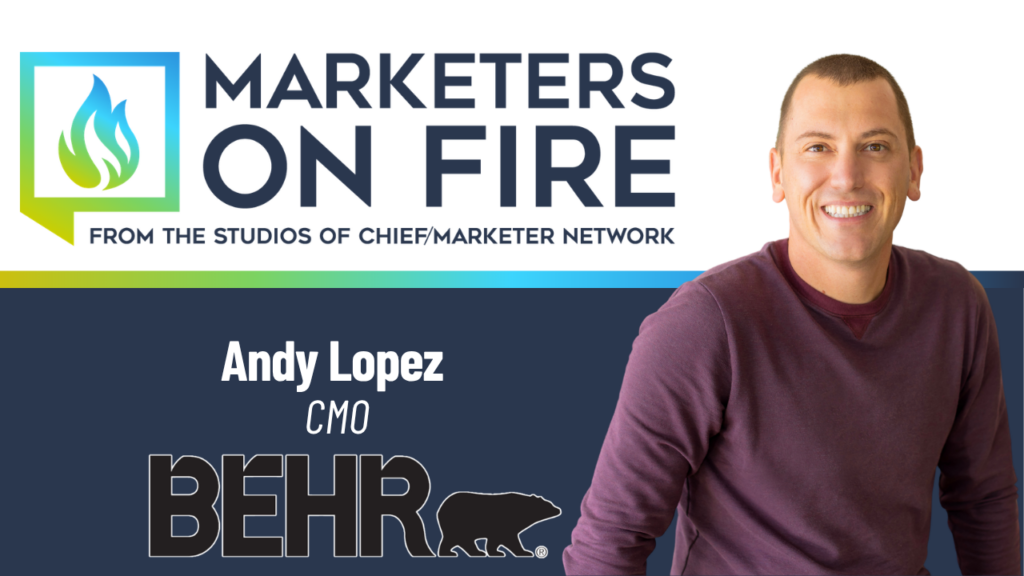
Andy Lopez was elevated to Chief Marketing Officer of Behr Paint Company last month after spending nine years building its marketing organization. In his new role, Lopez has an expanded mandate that includes product strategy and innovation alongside marketing oversight, with a clear focus on unifying the consumer experience across Behr’s digital ecosystem.
In the weeks since his promotion, Behr relaunched its website, repositioning it from an ecommerce shop into what Lopez calls a “color destination,” and has continued building out ChatHUE, its AI color tool built with Google Cloud. Behr’s marketing moves point to a single premise: that the single hardest part of any paint project is picking a color. With new tools and a more seamless experience, the brand is committed to help consumers solve that pain point.
We spoke with Lopez about his new day-to-day, how Behr is thinking about defending itself against AI search and declining web traffic, why creators should have freedom to shape their own messaging and the brand’s steady expansion into the Pro segment. Watch our conversation, or read the transcript below, condensed and lightly edited for clarity.
Transcript:
Kaylee Hultgren, Associate Publisher, Content & Awards, Chief Marketer and PRNEWS: Hello, everyone. I’m Kaylee Hultgren, Associate Publisher of Content and Awards at Chief Marketer and PRNEWS. We are super excited to be joined today with Andy Lopez, the brand new CMO of Behr Paint. Welcome, Andy. How are you?
Andy Lopez, Chief Marketing Officer, Behr Paint Company: Thank you, Kaylee. Nice to see you again.
Kaylee Hultgren: So we’ve spoken to you several times over the years at your other roles, but first off, I wanted to congratulate you on your new position as CMO for the company.
Andy Lopez: Thank you. Much appreciated. Super exciting time for our organization. Super excited to just continue all the amazing things that we’ve done from a marketing perspective to really put the consumer at the center of everything we do, whether that’s a DIYer or a professional. There’s just so much opportunity to continue to provide some best-in-class experiences for them, and Behr is the brand to be able to do it. So excited to be able to work with the team at large in order to continue to make that happen.
Kaylee Hultgren: Excellent. So first off, let’s talk a little bit about your new role and responsibilities. I believe you have product strategy and innovation beyond marketing with this role. How does that change your day-to-day?
Andy Lopez: Yeah. So I think the role really has been elevated to ensure that we are truly putting the consumer at the center of everything that we do. And in order to be able to do that, we really have to think about the end-to-end experience. So what that means is all of the insights that we are gathering upfront is not only driving our marketing strategy and our execution from a campaign standpoint, but it’s also driving how we’re thinking about the segments that we want to go after, the products that we want to be able to develop for those segments, and then how does that really streamline and connect to what we put out there to the consumers we’re going after — again, whether that’s a DIYer or a pro. So I think just bringing that all under the marketing organization, and having the teams really be more connected than they ever have before, is really going to be able to deliver on that promise that we’ve always strived to do, which is what’s best for our end customer.
Kaylee Hultgren: So what are your major plans for the brand in the coming year and beyond? And maybe if you could reference some of the things, some of the recent programs that have been successful that you might want to continue.
Andy Lopez: Definitely. So I think one is what we just talked about, which is creating that connectivity and making sure that we’re bringing the best-in-class experience to our audience and to the customers that are buying our product. An example of that is really looking at our digital transformation, and it’s really a journey that we’re on — it’s not a one-stop shop. Last year, we created an AI tool in partnership with Google called ChatHUE. The purpose of that was we understand that color is one of the largest pain points that happen on the consumer journey. It could be a super overwhelming process, and our goal really was to be able to take that data, understand what those pain points are, and develop a solution that’s really going to solve those pain points — not just create technology for technology’s sake.
ChatHUE was launched last October. We’ve continued to optimize it based on consumer insights. One of the things that we saw was that people wanted to visualize the color that we were recommending in their space. So what we did was we quickly created a visualizer within the tool for people to use, and we saw our customer satisfaction score jump 15%. Instead of just developing an AI tool that can solve everything at once, we took a strategic approach to start with just interior paint, just color, and build and expand beyond that — totally driven by consumer behavior and it being live on our website. In addition to that digital evolution, we really optimized our website. We just launched it last week in order to be a color destination.
Prior to us launching this new website, it was really built as almost an e-commerce site where people can determine where they’re coming in and decide what info they’re looking for. But leveraging the data that we had, we knew the most time spent and the most engaged consumers were really focused around color. So now when you go to behr.com, it really creates that color destination. You’re able to navigate the site to understand: do you want to look at the color wall and the digital platform like you’d see at Home Depot? Or do you want to leverage ChatHUE as a tool to focus in on one color? Or do you want project inspiration — depending on the project you’re working on, what are some color palettes that work specifically for that project — that can help drive some of that inspiration and help make that color selection process a lot easier.
Kaylee Hultgren: So that all came from insights, customer insights where color was the sort of source of insecurity, right? Can you talk a little bit about that?
Andy Lopez: Yeah. So based on our journey insights, color was the favorite part of the process, but it was also the most difficult part of the process. When we dug in deeper to those insights to understand what that means — it was that color at the start, the inspiration, going to different social platforms, understanding the possibilities of what could be, was very exciting to consumers. That process didn’t feel overwhelming at the start. The most difficult part of that process was when you actually had to put a stake in the ground on one color. That’s when the anxiety hit. That’s when the overwhelm set in — am I making the right choice? What’s the validation that I can get? There are so many different options of white, so many different options of different hue families.
So that’s where we really wanted to focus our effort — on the difficult piece of the process, what can we do as a brand to truly solve that? And that’s where we really narrowed in on ChatHUE, to have something that is scalable that can really help people narrow in and solve that specific pain point.
Kaylee Hultgren: Do you have any evidence of these tools actually shortening the purchase journey? What kind of evidence do you have?
Andy Lopez: Yeah, I think the evidence that we have is not necessarily just shortening the purchase journey. The evidence that we have and that we’re looking at is the time spent within ChatHUE, and what high-value actions are they doing within that experience. We are seeing an uptick — paint is still a very large category that’s purchased in store. So what we’re seeing is people are getting through the process of ChatHUE, and they’re putting in their zip code to identify where the closest Home Depot is, which is a great indication for us that we’ve made them narrow in on a color that they feel confident about, whether they’re purchasing it at the store or on homedepot.com. So that’s been a great assessment to understand how our tool is working.
I think also just understanding what we initially wanted it to do, which was narrow in on interior paint colors, was working, but also identifying, as I mentioned, the visualizer — what that could do, and what people were looking for there. We also have a roadmap of what else we want to do on the platform, which is exterior colors, and also understanding how we can offer product support. So we’re really just continuing to leverage real consumer data in real time in order to make these optimizations, and seeing the success based on usage, based on customer satisfaction, and based on some of those high-value actions that I mentioned.
Kaylee Hultgren: A lot of websites are facing lower traffic numbers because of AI search, AI answer engines. So is this, in part, building all these tools and connecting them to your website experience — is it in part a way to create some defense from your product and your colors and your tools being boiled down to an answer in a large language model?
Andy Lopez: Yeah. You know, I think what we’re trying to do is really optimize the experience, and at the end of the day, we do want to offer something that is very unique to Behr. So I think when you think about what our platform is able to offer within ChatHUE versus what you can get on some of the other large language models — and mind you, we are working with Google, we’re working with Gemini and their cloud services in order to feed into this — but we have proprietary data at Behr. If you think about our scale with Home Depot and the 2,000 stores that Behr is available in, we have a lot of color-hit data that gives us a lot of great insights as far as what colors are being used, both from a geography standpoint, and we understand a lot of trends and insights that help us understand what colors are best used for different projects.
So in order to get to a point where you’re able to engage with this tool, we’re offering very specific Behr colors that work exactly with what you’re looking for and what you’re hoping to get out of it, so that when you go into the store, it’s seamless and it’s connected and you won’t have any issues finding that color. Right now, when you go on any of these other large language models, it’s offering you a wide range of different colors, different brands, some colors that aren’t even available in store. Our goal is to continue to figure out how we can be unique — what value prop can we add that is a unique experience for people who are specifically looking to tackle a painting project, and how can we just be their coach throughout that process?
Kaylee Hultgren: So we’ve talked a little bit about AI, how AI fits into the consumer-facing tools that you’ve created. Are you using AI within your marketing organization for efficiencies or strategy or anything similar?
Andy Lopez: Yeah, we are always looking at tools that could help make us even more productive than we are today. I think that’s been the baseline of how we’ve approached some of these tools that are out there — really understanding, are there things that we can do to help provide more productivity, so that our teams are not only able to work on the amazing things that they’re working on, but they’re able to do even more of that at scale and at a much faster rate. So that’s really our goal — to understand how these tools can help make our organization more efficient, more productive. But it’s also being mindful that we always want to ensure that our brand is showing up in the way that meets the standards of when we’re not using AI. So that’s been another really focused area for us, as some of the teams are exploring with some of these AI tools.
They continue to get better, they continue to evolve, but we’re always making sure that the brand is represented in the best way possible. So that’s been more of the exploratory phase of how we’ve looked at AI, how we’ve used AI — more from a testing standpoint, to understand what the capabilities are and really understand what the opportunities are on a go-forward basis.
Kaylee Hultgren: One campaign that we wrote about in the past was your Behr Hotline. If you wouldn’t mind talking a little bit about that program and how you worked with creators, and how you approach ROI when it comes to creator content, and how much latitude do you give them?
Andy Lopez: Definitely. So the Hotline was really in order to solve some pain points that we were seeing based on insights — not even insights that we were doing the research on our own, but really insights from social listening and understanding what consumers were asking for, what felt like some of the pain points they were facing, not only within the Behr brand but within the painting category in general. That helped us understand how we can be more available to answer any questions people have, because not all the same knowledge is being transferred down by generation, in order to have the same DIY skillset that other generations had at the same age when they were buying a new house or taking on new projects for their home.
So really what we wanted to be is that coach to help them throughout that process, and that’s really what established the idea of the Hotline. The way we thought we could bring that to life and amplify it in an even bigger way was through partnering with creators who were really within the DIY space, but also in other areas too — whether that’s from a financial perspective or a design standpoint. We really wanted to make sure the content creators we had had some diversification in what their offerings were, so we could answer as many questions as possible, no matter what the question is — whether it was picking out a new color, what sheen to use, which white to use if your house is north-facing versus a different position.
And the creators were already huge fans of the brand. So we give our creators a lot of latitude as far as what they’re able to do as it relates to our brand. We work with them on what the objective is, what we’re trying to communicate, what we’re trying to achieve, but we always want the message to feel very authentic to what they’re trying to achieve on their own platform. And I think that’s really critical from a brand standpoint — we want to make sure our creators are partnering with us, but they feel like the content they’re putting out there is authentic to who they are and what their goals are and what they’re trying to achieve with their audiences. Because that’s the whole point of why brands hire creators, right? If I just want to do a message about Behr, then we publish that on our own platform. So you have to be very sensitive and mindful to what the creators are also trying to achieve, and really work together as a partner in order to create the best content that’s going to perform the best as well.
Kaylee Hultgren: Yeah. And more and more, people are more likely to believe creators, as long as they stick to being authentic within their own world — people want to hear it more from other people than —
Andy Lopez: Exactly. It’s that third-party validation. And even with the AI tool we put together with ChatHUE, when people are choosing color, they almost just need that little — they don’t need the highest-end designer to tell them it’s this color. Some people are looking for that and they’ll hire a designer for that. But some people just need that little validation in order to say, “Hey, I feel good about choosing this color.” Because at the end of the day, we want it to be the person’s choice, because they’re the ones living with it, and they’re the ones who have that story, that narrative of why they chose that color. So we never want to take that away — we just want to be an assisted tool, whether they’re getting ideas to provide to their designer, to their pro, or if they’re taking on the project themselves. It’s not to replace any of that. It’s only to help guide them and make them feel confident in whatever color they choose, however they’re planning to tackle the project.
Kaylee Hultgren: Are you going to continue to court DIYers, or are you expanding to other different audiences?
Andy Lopez: Yeah. DIY is a segment that we have always gone after — we have always been in the spirit of DIY, that’s how our brand started. But over the last several years, we’ve had significant gains with our pro audience, and we’re super excited about some of the traction we’re getting there. We just made KILZ exclusive at Home Depot from a big-box perspective last year. That’s been a great way for us to really bring the power of both of our brands together in order to offer Pros a one-stop shop for their projects as well. So again, everything we’re doing goes back to what we can do to really help our end user.
So Pro continues to be a segment that we’re going to go after. There are a lot of different professionals — you have a pro painter, and designers and architects are part of our Pro strategy as well. So there are a lot of different ways our brand can show up in a way that’s beneficial for them, depending on what they’re looking for from a brand like Behr.
Kaylee Hultgren: And just to touch a bit on your Home Depot partnership, that’s been, I think, 45 years. What’s the benefit of that exclusivity that you have with them, and what is, say, a potential challenge?
Andy Lopez: Yeah. I think the benefit is that we truly have an amazing partnership with their team across their entire organization — not only from the merchants and the team that’s driving the specific paint department, but also within their marketing team and how we’re going to market with different campaigns, how we’re going after certain areas where we feel like there’s growth opportunities in different segments. Home Depot is taking a very consumer-centric approach as well, as far as whatever they’re doing. So I think the biggest benefit for us is just how we can really work with each other as an extension of each of our teams, in order to help grow our brand and help grow Home Depot overall. And I think those synergies, that passion, that excitement really plays amazing together when we’re thinking of new ideas and new initiatives that are really going to help the business grow.
Kaylee Hultgren: Let me close out with a couple of questions about the CMO role in general. Not every company has a CMO — some are converting, changing the name, putting “growth” in there, because that’s more and more an important part of the role. Behr is obviously supporting the CMO role itself. What do you think that says about the company itself and the marketing role within the business?
Andy Lopez: Yeah. I mean, I think there is a huge belief in what the impact of marketing can be, and that’s always been a belief from our organization. We know the impact that marketing has on a brand. We know how sacred and amazing the Behr brand has been, well before my time, since it started, and how it’s continued to grow with our partnership with Home Depot. So I think, no matter the title, we know what’s true is that the CMO role, or the head of marketing role, is continuing to evolve and change based on everything that is available today. When you think about AI, and you think about content at scale, and you think about consumer centricity and how that’s continued to evolve, and how experience — how important that is and what we’re doing to make it more seamless and interconnected, so that people can leverage the devices they have to learn about your brand and you’re offering that same experience in store — it’s continued to become more complex, but I think that’s what makes any role in marketing more exciting, is that it’s never the same.
You’re always learning, you’re always continuing to get challenged, and you’re understanding how we’re able to leverage marketing as an impact to truly grow and make the business as successful as it can, as one lever to be able to pull. So I think that role can show up in many different ways across your organization. But I think what it comes down to is, are you able to do the things that you believe are the most important things — that feel, or that you can prove out, have an impact on the business? And I think as long as there’s a platform for that, that’s what makes our job so exciting, that’s what makes us attract new talent, that’s what makes brands continue to succeed — because they understand the true impact of marketing and what it could do, not only for the brand, but for the business at large.
Kaylee Hultgren: And last question for you, Andy. What are some of the biggest challenges for a CMO today? Obviously you just started, but you’ve been in marketing for a long time now, and you know the job and what it takes. So what are some of the challenges, and maybe a couple of qualities it takes to succeed?
Andy Lopez: Yeah. So I think I’ll start with the latter part of the question. I think the qualities it takes is just continuing to be passionate, continuing to be curious — not only about what can impact the business tomorrow or next year, but also, at the same time, thinking about the long-term vision of what’s around the corner, what you need to stay ahead on, what you need to think about that may not have a short-term impact but can really put you ahead or give you a competitive advantage from a long-term perspective. So I think that’s really critical in order to be successful at any level within a marketing organization.
From a challenge perspective, there’s so much evolving, and we kind of hit on this already, as far as how the role of CMO has evolved. And I think, at any level of marketing, you’re continuing to have to understand what are the different things you need to consider, what are the new tools you have to learn, what are the new ways of measuring impact. And you have to be able to take all of that and understand how it applies to your business, your larger team, your organization, because it’s not a one-size-fits-all approach. I’ve been in many rooms and many different discussions with other marketing leaders across other organizations, and it’s never this silver bullet where it’s like, “This is it — if we all did this, we would all be amazing marketers.” So I think you have to really understand that no matter where you’re at in your role, no matter which organization you’re at, from a marketing perspective, everything’s going to require some customization in order to be successful in your role, at whatever brand or organization you’re at.
And I think that could feel like a challenge sometimes, but it can also be just as rewarding, once you’re able to see the impact of what that can do.
Kaylee Hultgren: Excellent. Well, thank you so much, Andy, for taking the time to chat with us today. We really appreciate it. Congratulations again, and hope to see more of your excellent work in the future.
Andy Lopez: Awesome. Thanks so much, Kaylee. It was great seeing you.