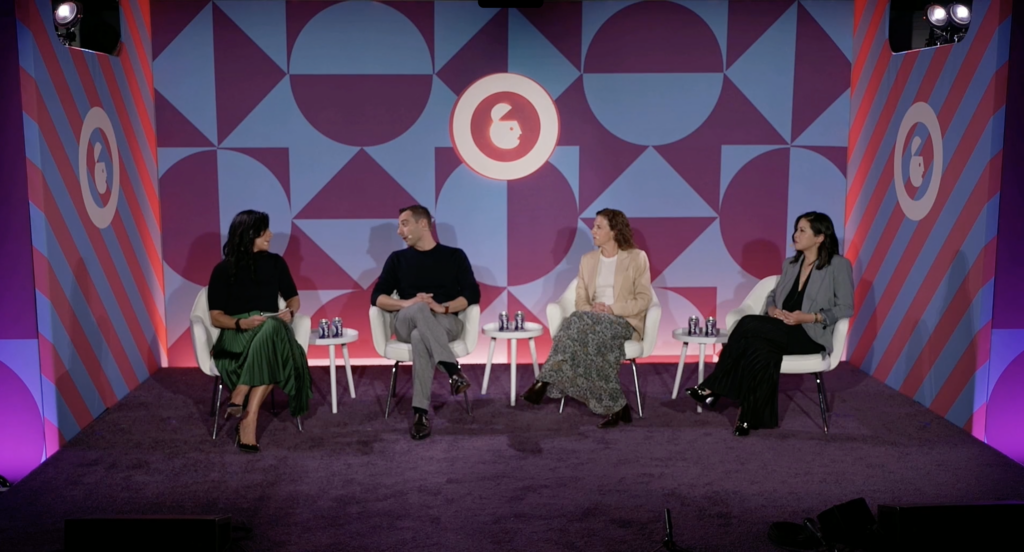
A panel of marketing leaders at Advertising Week New York argued that brands earn credibility through visible action: providing value, delivering on their promises and choosing partnerships and cultural conversations that fit.
The discussion focused on how brands can stay relevant as audiences and culture shift. For Stacy Tappitt, Chief Growth and Marketing Officer at The Hershey Company, that challenge is especially clear for legacy brands. “You can be loved but not chosen actively,” she said. The panel explored how marketers try to move brands from familiarity to active consideration, including through useful content, partnerships and decisions grounded in brand values.
Value Before Trust
Each example cited by panelists started with the same question: what does a brand give its audience in exchange for their attention or loyalty? For LinkedIn, it’s making information about the world of work available to members and policymakers. The company’s economic team tracks hiring and skills trends, then publishes research, Paolo Provinciale, Vice President of Marketing at LinkedIn said.
“It’s not what you say, but actually the way you show up,” he said. “Provide value to your audience before actually asking for that credibility and trust back.”
LinkedIn also presents careers as less linear than traditional success stories suggest. The company showcases people whose careers changed direction, Provinciale said, because “their linear career progression was not linear at all, [it] was actually a zigzag, a step back, a step forward.”
Lori Lamb, Chief Brand Officer at e.l.f. Beauty connected e.l.f.’s credibility to consistency between stated values and company behavior. “It’s also the consistency of playing [out] values, so not just delivering values, but standing behind your values,” she said. She described e.l.f.’s “zero distance” culture as a way to expose employees at different levels to company decisions.
For Hershey, the challenge is ensuring familiarity doesn’t turn into passivity. The company has 90 brands at different stages of maturity, Tappitt said, and each has its own relationship with consumers. For legacy brands, the task is “being top of mind and being relevant every single day.”
Partnerships Have to Add Something
Partnerships are one way to deliver relevance and credibility, panelists said. Hershey looks for partners that share its values. “We look for brands or partners that share our values, maybe have a common mission, but that can offer something complementary to both brands,” Tappitt said.
She cited Reese’s collaborations with Oreo and Nitro Bar. Tappitt said the Nitro Bar partnership introduced a Reese’s pumpkin latte and reached a younger consumer while opening “a new occasion where people are making recipes and using the products in different ways.”
At e.l.f., Lamb said community conversation helps inform partnership choices. The company collaborated with Bubble, another beauty brand, and combined products from both companies. Lamb said e.l.f. looks for a distinctive contribution from each partner rather than a collaboration that any two brands could do.
LinkedIn’s partnership examples focused on personal career stories. Provinciale described working with DJ John Summit, a former accountant and Las Vegas Raiders NFL player Fernando Mendoza, who used an “open to work” banner while waiting for the NFL draft. For LinkedIn, he said, the stories show how people navigate professional change.
Choosing When to Join the Conversation
The same question applies when brands respond to trends. Provinciale said marketers should decide what they can contribute before joining in. “The overarching rule is not to ask yourself how can I jump into the conversation, but what can I add to the conversation,” he said.
Lamb described e.l.f.’s approach as shaping culture rather than chasing every trend. “We’re not chasing trends, but we’re shaping the way that the narratives are built,” she said. She also warned that purpose can become a platitude if it is not tied to action.
That judgment becomes harder when criticism spreads quickly or when misinformation appears. Tappitt said Hershey prepares content to address likely questions and builds the ability to respond quickly. When a brand has made a mistake, she said, it should acknowledge it and try to make it right: “You own up to a mistake. You’re transparent about it. You try to make it right, and you live to fight another day.” In the end, it’s about making credibility visible in a brand’s actions — what it offers, whom it partners with and how it responds.