Of the roughly 133 million households in the U.S., nearly 74 million buy and consume honey, according to market research firm Numerator. But while sales of honey grew nearly 6% over the past year, lack of awareness of honey’s versatility and wellness benefits is preventing even more growth, according to Becca May, Senior Vice President, Marketing and Innovation for Nate’s Honey. To that end, the brand has partnered with athletes, influencers and, most recently, Lipton Tea.
Partnership Power
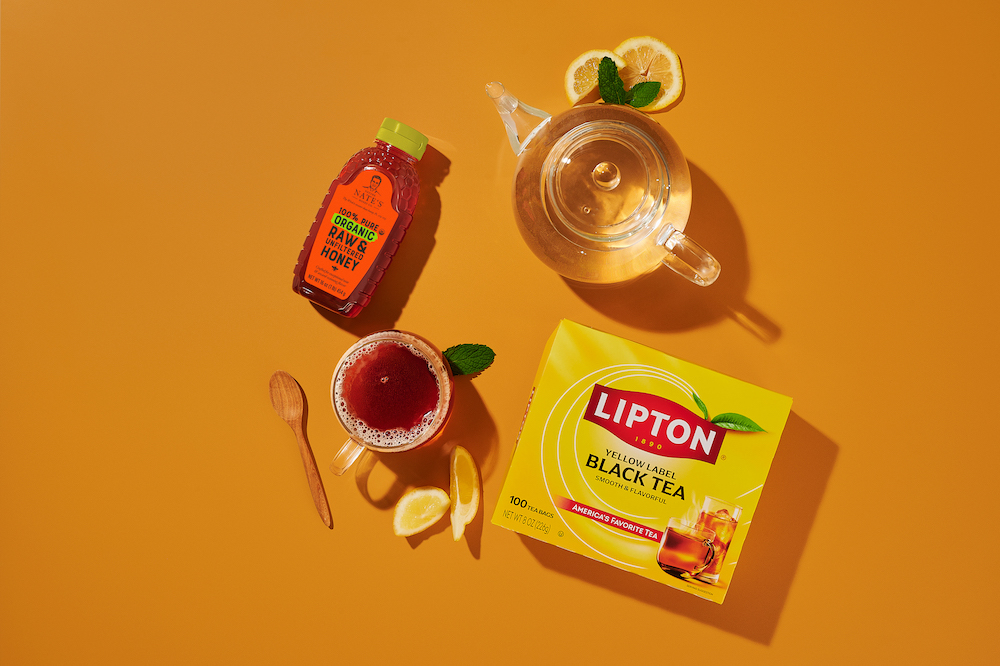
Nate’s Honey announced its partnership with Lipton Tea, spotlighting the latter’s Tazo brand, in October. The campaign, “The Sweetest Duo,” includes digital displays, display ads and co-branded in-store displays and events with Amazon, Instacart, Kroger, Target and Walmart, along with sampling, influencer marketing and a social giveaway.
Nate’s and Lipton are well-known brands in their categories, so leveraging the power of each other’s significant audience seems a no-brainer — given that tea and honey are a grocery power duo on a par with peanut butter and jelly. Yet there haven’t been any previous nationwide partnerships between tea and honey brands, which May believes is largely because until recently there wasn’t a brand leader in the honey category: “Nate’s Honey is the first national honey brand.” Just shy of 8 million households purchased Nate’s Honey in the past year, giving it nearly 11% market share.
Partnerships have long been a major element of Nate’s marketing efforts. Beginning this past April it teamed with sports, dining and entertainment complex Texas! Live to display ads at Globe Life Field, AT&T Stadium and other sites. The deal also allowed Nate’s to give away samples at more than a dozen marquee events, including Shakira and The Weeknd concerts and the upcoming Cotton Bowl and New Year’s Eve celebration. Among other recent partnerships, Nate’s collaborated with upscale organic food market Erewhon and wellness influencer Nara Smith on an exclusive smoothie, a follow-up to previous Erewhon smoothie collaborations with pop musicians/actors Sabrina Carpenter and Olivia Rodrigo.
Millennials, Gen Z and Athletes
Nate’s Honey’s choice of collaborations and partnerships reflects its efforts to engage with Gen Z and millennials, though May is quick to say that its consumer base is diverse. Even so, she believes the brand performs particularly well among the younger demographic cohorts in part because “they’re highly aware and invest in their health and wellness, and honey fits in very well with that,” she says. According to the brand, 71% of its core customers buy the product for health benefits rather than just as a sweetener.
To that end, Nate’s has worked with nearly a dozen fitness influencers since June 2024, including Margo Oshry and Terrence Bradshaw. It also partners with athletic communities such as 29029 Everesting, giving away single-serving Honey Minis to event participants. Since the launch of its Honey Minis athlete campaign in June 2024, sales of the product grew 174%, with 76% of buyers new to the brand and 26% making a subsequent purchase within three months.
Among runners, sales of Nate’s Manuka honey increased 31%, buoyed by the brand’s promotion of its wellness benefits. Sourced and packed in New Zealand, Nate’s Manuka line also overindexes among male consumers. The brand’s decision to market the product largely toward men resulted from what it was already witnessing online. “We saw guys were using it as a vitamin, as part of their daily health and wellness. Frankly, no other honey products are talking to them,” May says.
Growth by Listening
An important tool in Nate’s Honey marketing kit is its eagerness to listen and respond to its audience. In fact, it’s how the brand developed its Honey Minis a decade ago. “People posted they were putting Nate’s Honey into zip bags when they were running and on the go. So we put it in mini packs,” May says. “The use has expanded beyond our wildest dreams.”
May’s team includes three members dedicated to social media. “If you leave a comment or make a review, my team is the one engaging with that,” she says. Responding and monitoring social feedback “is the coolest part of the job. We want to hear the good, the bad, how they’re using our honey. It’s truly the key to the heart of the brand.”
She also believes that interacting with the audience directly, rather than outsourcing engagement to a media company, has contributed to the brand’s growth among millennials and Gen Z. “They crave authenticity from the products they’re investing in and the brands,” May says. “We’ve kept our consumer at the center of everything.”