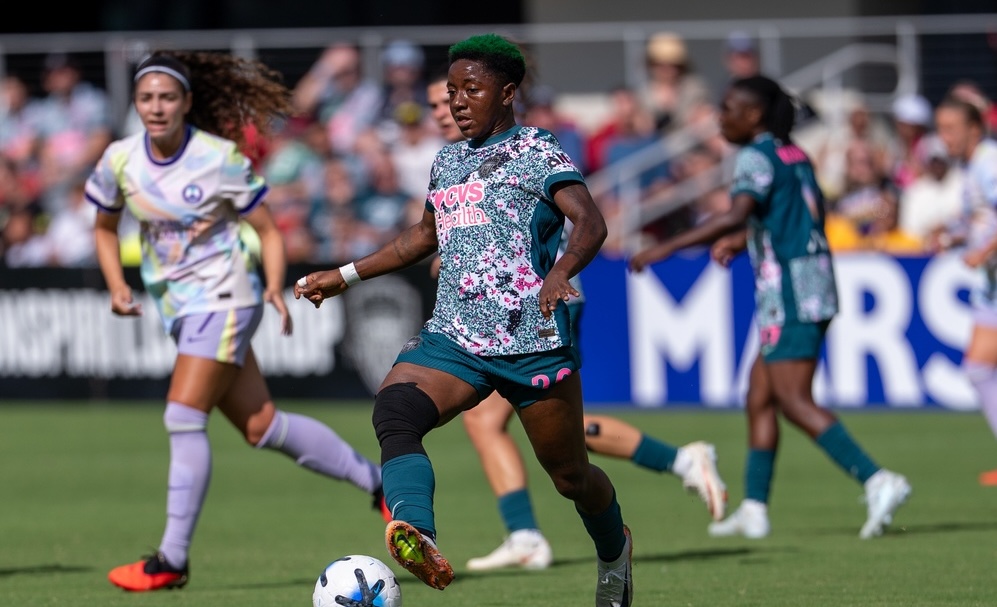
Marketing leaders are expected to drive revenue and improve the customer experience, yet many CEOs still don’t see marketing as a primary growth lever. That tension framed a panel at the Mid-Atlantic MarCom Summit in Washington, D.C., Oct. 14, where executives from consumer goods, professional sports and government contracting discussed how they measure brand and stand out in crowded markets.
Their examples showed how brand can support loyalty, ticket sales, partnerships and recruitment. But connecting marketing activity to measurable business outcomes remains a challenge.
“The ‘business’ part of our business wouldn’t be possible if we didn’t have a strong Big B,” said Kim Bolt, Chief Marketing and Strategy Officer for the Washington Spirit, the D.C. women’s soccer team. In this instance, the big B stands for branding.
Brand Must Prove Its Business Value
For Just Ice Tea, brand is tied to repeat purchases and customer recognition. The four-year-old beverage company, which Allison Moss, Head of Marketing at Just Ice Tea, described as mission-driven, has made brand an objective in its annual OKRs (Objectives and Key Results). Its measures include household penetration to track trial, repeat purchases and awareness. Just Ice Tea is now in more than 20,000 retail locations, Moss said.
“Brand is about loyalty. It’s about retention,” Moss said, describing the connection between consumers’ sense of the brand and their decision to choose it again. The company tracks multiple measures because, she said, “It’s the combination of those things that tells the whole picture.”
The Washington Spirit takes a different approach. Marketing cannot control whether the team wins, Bolt said, but it can shape the story around its players, its connection to the community and the experience fans have at matches. The team tracks its average Net Promoter Score as an indicator of brand health. Bolt put that figure at 82, compared with roughly 50 to 60 for other live sporting events.
Distinctiveness Starts With Proof
In government contracting, Sheila Blackwell, Chief Marketing Officer at defense contracting firm ManTech, said companies in the space often make similar claims about cybersecurity, data, and artificial intelligence. That meant that ManTech needed to differentiate itself in the market. With about 60 years in business, it used brand sentiment research to examine how it was perceived internally and externally. After an initial survey raised questions, it conducted two more. The company decided it didn’t need a full rebrand, but it did pursue a visual refresh and a clearer account of what sets it apart.
“We are the best kept secret in the secret keeping business,” Blackwell said, describing the challenge of raising ManTech’s profile while serving the intelligence community. One point the company emphasized through brand work was that almost 40% of its employees are veterans. Blackwell linked that experience to the company’s initiatives supporting defense agencies.
“We know them because we are them,” said Blackwell.
Distinctiveness needs to rest on something the organization can credibly claim, panelists agreed. For Just Ice Tea, Moss pointed to its organic, fair-trade ingredients and lower-sugar recipe. For the Washington Spirit, Bolt described the team’s connection to Washington and its fans as part of what distinguished it from other local sports teams.
From Audience to Advocacy
Moss described building a “brand world” by carrying the company’s values and visual identity across customer interactions, then creating opportunities for customers to interact with one another. Just Ice Tea launched a website loyalty program that Moss said was partly about accumulating points, but really meant to get customers to join a conversation. Customers can share how they recycle the brand’s bottles or cans, creating an occasion for others to respond.
On the other hand, Bolt drew a line between a customer and a more committed supporter: “A customer is somebody who buys a ticket, but a tribe is an audience who wants to bring a friend.” The Spirit uses matches and other events to build community while also giving season-ticket members access to players and the front office.
The team also used focus groups to hear how fans felt about their relationship with the club. When asked how it would affect their daily lives if the Spirit disbanded, some said they would lose “their sense of faith in humanity,” Bolt recalled, underscoring how deeply they connected to the team.
Sales and Marketing Share the Growth Goal
Sales and marketing are a dynamic duo that should work together to achieve growth goals, Blackwell said. Marketing can’t set the price or change the technology, but it can shape a client’s view of the company before sales gets involved, she said. By then, “they already know who you are. They have an opinion of you,” Blackwell said. She argued that this familiarity can make a buyer more willing to consider a higher price.
At the Washington Spirit, shared OKRs clarify how marketing supports ticket sales. Bolt said the ticketing team owns season-ticket sales, while marketing is a key contributor. The team also uses a RACI model — a responsibility assignment matrix — to define the sales-and-marketing partnership.
At Just Ice Tea, the collaboration includes sharing what each team learns from customers and the field. Moss said sales and marketing have worked side by side throughout her career. Her team sets annual objectives collectively with sales, operations and company leaders.
“Maybe that price might be a little high, but they’re willing to go because they know everything about you. And that’s the power of the big B,” said Blackwell.