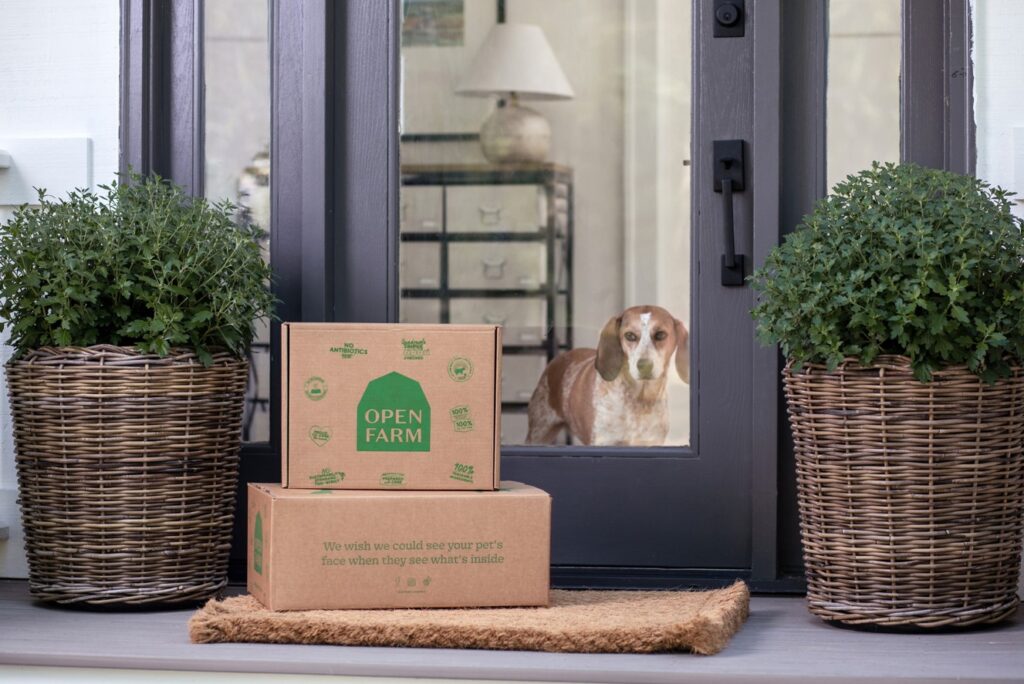
Brand awareness doesn’t pay the bills, said Mark Sapir, Chief Marketing Officer at Open Farm.
Despite being fixated on awareness as a metric, Sapir knows Open Farm’s campaigns and overall marketing strategy have to drive sales.
Fortunately for Sapir, the brand’s most recent campaign is doing just that: In March, the premium pet food brand launched a campaign in two test markets, Florida and Texas. For retail stores that sell Open Farm products, sales increased 6% in Florida and 19% in Texas compared with markets where the brand is not advertising.
In addition, sales on its direct-to-consumer site went up, although to a lesser extent (4% in Florida and 7% in Texas). Sales also increased on its Amazon.com products, and its organic search traffic got a boost as well. The campaign-driven growth is on top of the brand’s typical sales growth, which is higher than 19% annually, he said.
Open Farm is excited that retail stores were the “big winners” in the campaign test markets, as it knows that it has to earn shelf space and keep its wholesalers happy, Sapir said.
These sales lifts occurred within six weeks, much faster than the four months the brand typically expects for its marketing campaigns to show up in sales, Sapir said. Pet food typically has a 30-day purchase cycle and is a more considered purchase than fast-moving consumer goods, which is why four months is the expected time frame.
The results were both surprising and exciting for Open Farm, and gave the brand confidence to expand the test to now six U.S. markets, as well as Ontario, Canada, where it is headquartered. The brand plans to have the campaign nationwide by the end of 2026. The campaign roll out is similar to how Open Farm has grown its business — slowly, with testing and optimization along the way.
Campaign Specifics
The campaign is a platform the brand plans to come back to, with the message “Pets Are Perfect. So, We Must Be, Too.” It has two commercials that will do the “heavy lifting” on connected TV, and Open Farm plans to push this message throughout the funnel.
The brand has several metrics it is using to measure the campaign’s success, such as increases in brand awareness, organic web traffic and sales velocity. What Open Farm truly cares about, however, is whether the campaign contributes to the brand’s growth plans, Sapir said.
“Ultimately, you can measure anything you want to, but at the end of the day, advertising needs to sell product,” he said. “We’re patient for it to happen, but it has to happen.”
Pivoting to the Upper Funnel
While patience for results is the expected reality for the marketing department, the finance department is less excited about this news.
“CFOs tend to be less patient and they want to see impacts immediately,” Sapir said. “With top-of-funnel, you don’t see the impact immediately. It’s harder to measure. There needs to be a bit more patience and a bit more confidence in what the team is doing. And I’d say we’ve earned our stripes as we continue to lean in and spend, and I think our finance team is more aligned.”
In the digital age, top-of-funnel marketing is becoming easier to measure, with guiding metrics such as organic traffic and click-through rate. For example, in this recent campaign, Open Farm noticed that it wasn’t performing in Northern Florida, and so it shifted its dollars to Southern Florida.
The campaign marks its first investment in brand awareness marketing, while previously it focused on product and performance marketing. Open Farm is 12 years old and has grown the business conservatively and steadily, Sapir said. After achieving profitability roughly four years ago, the brand is now at a “tipping point,” where it can lean into brand awareness, he said.
“We’re now at a point where we know our funnel — outside of missing awareness — is incredibly strong,” he said. “Our conversion rates are strong, our loyalty rates are strong. And we now have the scale.”
Sapir would not give specifics on repeat purchase and conversion rates but said, “About half of the people that see our brand and are exposed to our brand are purchasing, and our churn rate is incredibly low.”
Plus, its conversion rate is on par with brands who have two to three times higher awareness than Open Farm, he said.
Open Farm Builds Brand Through Efficiency
When Open Farm launched in 2014, it had to be “incredibly smart” with its money, Sapir said.
“For the first nine, 10 years, it was a lot through the lens of cost of acquisition; it was a lot through the lens of being as efficient as we can to get new pet parents in, making sure every penny works,” he said. “We didn’t have the luxury necessarily of putting more money at the top of the funnel.”
Now, the brand would like to have 60-70% of its overall marketing spend to be upper funnel, he said. Open Farm brought in a new chief digital officer and vice president of marketing to help with shifting spend to brand awareness.
The brand is now available in more stores — 9,500 with its recent addition of PetSmart — which makes top-of-funnel marketing more efficient as well.
But any movement on awareness will take time, Sapir said.
“A 1% change in awareness is quite seismic just given the household penetrations it brings,” he said. “But our brand awareness has grown steadily over the last 10 years. But in the last year, we’ve seen bigger lifts.”
Feeding the Content Beast
For modern marketers, brands need a lot more content to be successful, Sapir said.
“Content used to be a lot easier; You could do one or two spots,” he said. “It doesn’t work that way anymore. You need to have so much content to fill the funnel. Not only content to fill it, but content to replace content that isn’t performing.”
Open Farm produces 100 pieces of content every other week, all without AI.
Overall, the brand is hesitant to jump in on using generative artificial intelligence for marketing creative. As a brand that is focused on sustainability, it is still determining the best way to use the technology, he said.
Instead, the brand leans into influencers and brand ambassadors who use its products to help with the large quantity of content it needs.
Open Farm has gone this route since it launched and has no trouble bringing in content from its network, he said. “There’s something authentic about that and to us, there’s something irreplaceable about that,” he said.