
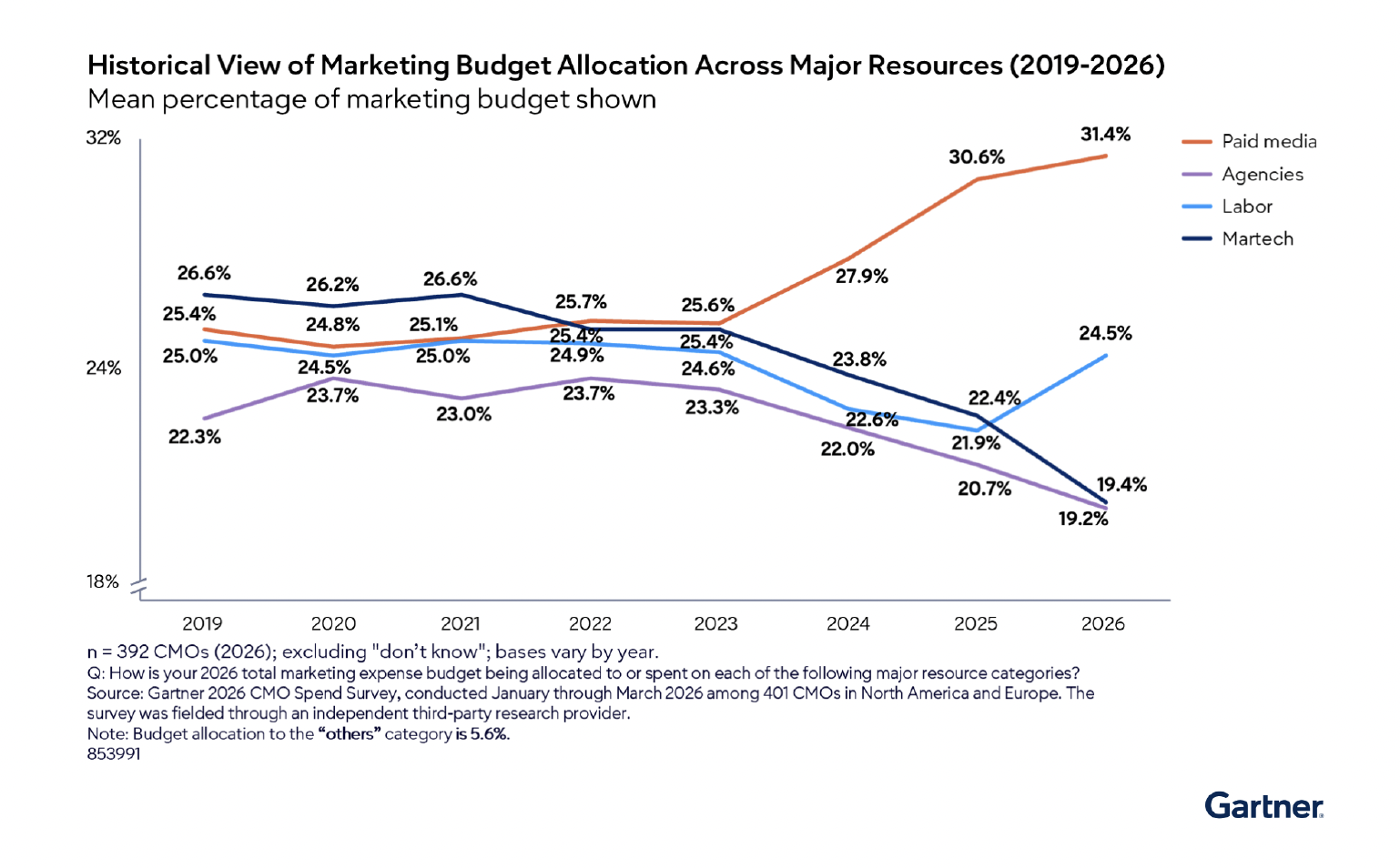
Given the continued emphasis on AI tools as a marketing essential, you might expect CMOs to be dedicating a higher percentage of their budgets than ever to martech. And in fact, 62% of the 401 CMOs who participated in the 2026 Gartner CMO Spend Survey were planning to invest more in marketing technology. At the same time, however, the mean percentage of marketing budget allocated to martech has reached a five-year low, from 26.6% in 2021 to 19.4%. These numbers speak to the complexity surrounding not just AI but also myriad other aspects of marketing budgets and priorities.
Consumption-Based Martech on the Rise
A shift toward consumption-based — also known as usage-based — martech solutions coincides with the decrease in martech as a percentage of marketing spend. In the past year, 56% of respondents have increased how much of their martech budget they’ve allotted to this pricing model; just 9% have decreased their allocation.
Many organizations see consumption-based martech as a cost-saving alternative to investing in applications and licenses they rarely use. But Gartner notes that the decline in martech budget allocation is not necessarily the result of wider adoption of usage-based models. Unexpected events, unforeseen usage trends or a lack of proper oversight can result in consumption-based martech costing businesses much more than anticipated.
Then there is the model’s additional administrative burden. Gartner found half of all organizations that have implemented consumption-based solutions are continually renegotiating contracts to avoid unexpected usage and cost spikes. To efficiently manage consumption-based models and avoid exceeding budget, Gartner recommends building oversight capabilities into existing processes. Already 41% of organizations have set up real-time controls or are doing so, and 24% are overhauling their systems specifically to reduce usage.
Innovation Spend Begets AI Maturity
Another potential factor in the reduction of martech as a percentage of marketing spend is that many organizations have already made their major tools-related AI expenditures and are now focusing on how to optimize those investments.
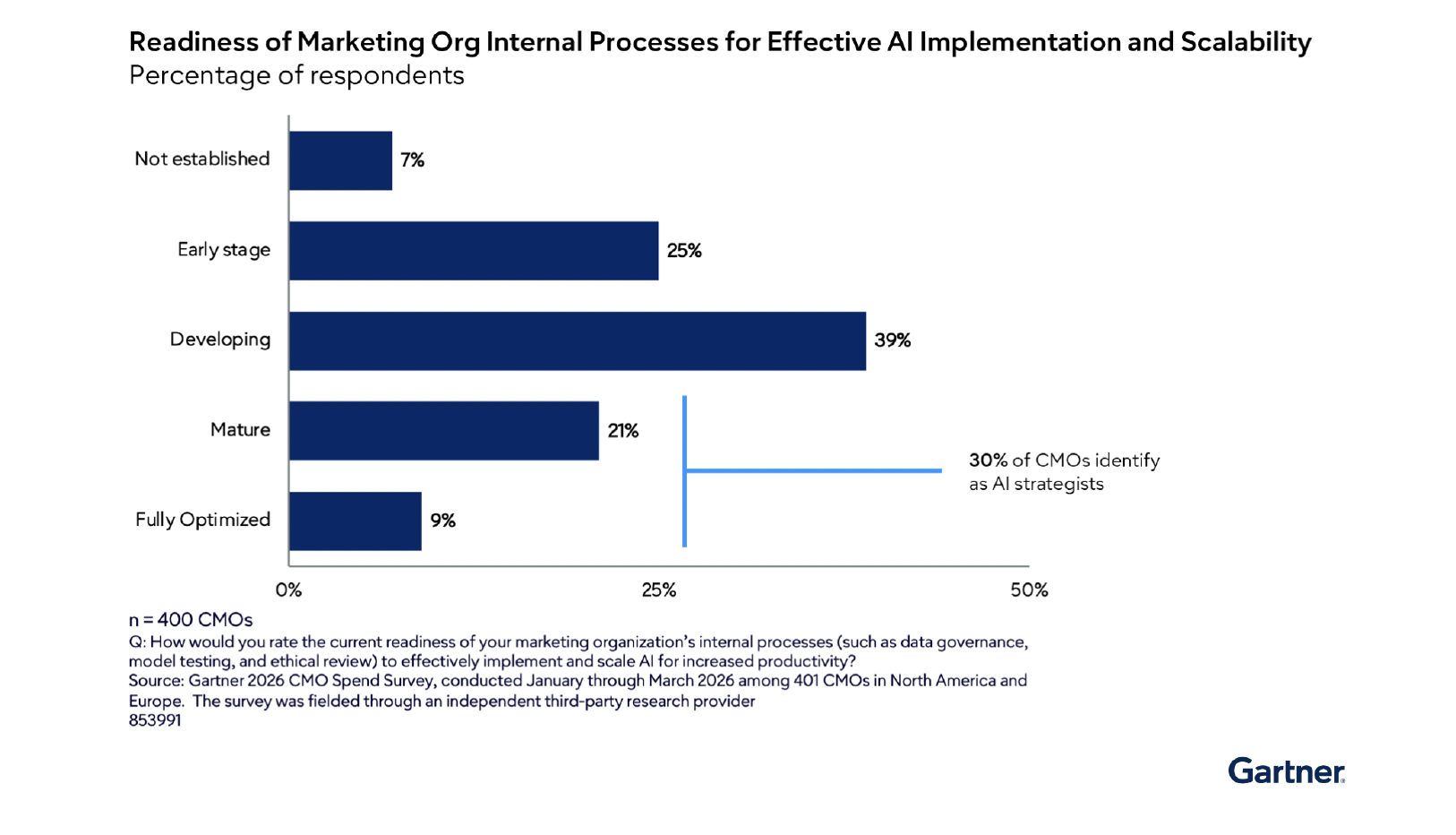
Only 9% of CMOs rated their marketing organization’s internal processes as fully optimized to implement and scale AI for increased productivity; another 21% considered their organizations mature in this regard. Gartner dubbed these marketers AI strategists. On the flip side, nearly one in four (39%) described their internal processes as developing, 25% admitted they were still in an early stage, and 7% had yet to begin establishing processes.
A lack of internal talent was the most frequently cited barrier to achieving AI-driven marketing efficiency. Nineteen percent of CMOs said it was their number-one stumbling block, and 38% ranked it in their top three. In second place was the lack of integrated marketing data, with 13% declaring it their primary barrier and 30% including it in their top three.
The need to attract or train talent in order to realize the full potential of their AI is a likely reason labor has increased from a mean 21.9% of marketing budget last year to 24.5% this year, according to the report. Even as they bemoan a lack of qualified AI talent, however, just 34% of CMOs anticipated spending more on labor this year, and 43% expected to reduce their labor expenditures.
CMOs who ranked their organization’s AI processes as mature or fully optimized were less likely to reduce their labor budget than other respondents, Gartner noted. They also dedicated appreciably more of their marketing budget to AI initiatives: 21.3%, compared with a mean 15.3% among all respondents.
What’s more, these AI strategist organizations allocated a mean 34.2% of their marketing budgets toward innovation, as opposed to efficiency or accountability. Among all survey respondents, the mean percentage devoted to innovation was a more modest 27.2%.
Great Expectations, Declining Performance
Marketing budget as a percentage of revenue also differed between AI strategists and other organizations. The former allocated an average of 8.9% of total revenue to marketing budgets, compared with 7.8% among all respondents. Further underscoring the link between budget allocation and AI supremacy: The marketing budgets of organizations with fully optimized AI — the top 9% of respondents — averaged 11% of total revenue.
With that increased allocation come increased expectations. While 73% of all CMOs said the C-suite had high or even overly ambitious expectations regarding marketing’s contribution to overall growth, among AI strategists that figure was 83%.
Nearly half (49%) of this year’s respondents reported exceeding their brand awareness goals, and 46% exceeded campaign impact objectives. In addition, 44% outperformed customer acquisition goals, 43% ROI objectives and 38% customer retention goals. That sounds impressive, until you realize such performance is short of last year’s. For instance, last year 58% of respondents had exceeded their campaign impact goals, 57% brand awareness goals and 56% ROI objectives.
Drilling deeper, 20% of all CMOs surveyed admitted that their department fell short of their customer acquisition goals, compared with 13% last year. Fifteen percentage failed to meet their customer retention objectives, 13% ROI goals and campaign impact goals and 12% brand awareness goals — all higher percentages than last year.
More than half (57%) of respondents agreed that their department lacked the necessary talent to successfully execute their 2026 marketing strategy, and 56% said they lacked the budget to do so. Unfortunately, a failure to achieve objectives this year due to a lack of resources could kick-start a spiral of underperformance. That’s because 62% of those surveyed said an inability to meet 2026 growth expectations would result in marketing budget cuts, compounding their problem.
To counter that, Gartner suggests sacrificing investments and initiatives that aren’t contributing to performance goals, no matter how entrenched they may be. It may require making some tough calls now, but failing to do so will likely lead to having to make even tougher calls next year in the face of budget reductions.
AI Adoption Contributes to Increased Paid Media Spend
In CMOs’ efforts to improve cost efficiencies, leveraging generative AI for content creation and personalization was the most popular transformative change, with 26% expecting it to yield results this year. Using AI to automate marketing processes was the second most popular, cited by 21%. Along similar lines, 22% said leveraging generative AI to personalize content and campaigns would be their top growth-driving transformative change this year. Another 16% named using predictive analytics for market and customer insights, and 15% said using AI to advance segmentation and targeting.
The increased adoption of AI to improve targeting and automate bidding goes hand in hand with an increase in the mean percentage of marketing expenses allocated to paid media. Whereas 25.1% of expenses were devoted to paid media in 2021, this year it reached a five-year high of 31.4%. What’s more, 53% of respondents planned to invest more in paid media, while only 25% expected to cut spend.
Digital channels accounted for 67.5% of marketing expenses, continuing a steady rise from 54.9% in 2023. Search advertising remained the top digital channel, accounting for 16% of CMOs’ digital marketing budget, up from 14.8% among last year’s respondents. Accounting for 15.7%, social advertising was a close second, up from 12.7% last year. Among owned and earned digital media, SEO accounted for the greatest percentage of mean budget at 9.4%, a slight increase from last year’s 8.9%.
At 23.1%, event marketing accounted for the largest share of offline marketing budget, up from 19.4% last year. Sponsorships were in second place, accounting for 18.2%, followed by linear TV at 15.5%.
Linear TV accounted for the largest share of offline marketing budget among B2C CMOs, however, with a mean 19.9%, compared with 13.2% for B2B organizations. And while B2B CMOs allocated a mean 27.6% of their offline marketing budget to events, B2C respondents devoted a more modest 16.5%.
Not only did CMOs overall allocate more than two-thirds of their marketing budget to digital channels, but such channels accounted for the top five areas where marketers intended to increase investment most aggressively. Digital video and streaming TV was the most popular channel for increased investment, followed by social advertising, SEO, search advertising and digital display advertising.
However, in another example of the complexity surrounding CMO budgets and priorities, social advertising and search advertising were also among the top five channels where respondents planned to reduce spend. Topping the list were sponsorships, followed by event marketing and influencer marketing.
Of course, all these budget allocations are subject to change — frequently, in some cases. One in five respondents said they reallocated more than 5% of their budget across channels monthly based on real-time performance. Another 38% did so quarterly, and 14% reallocated continuously in real time.