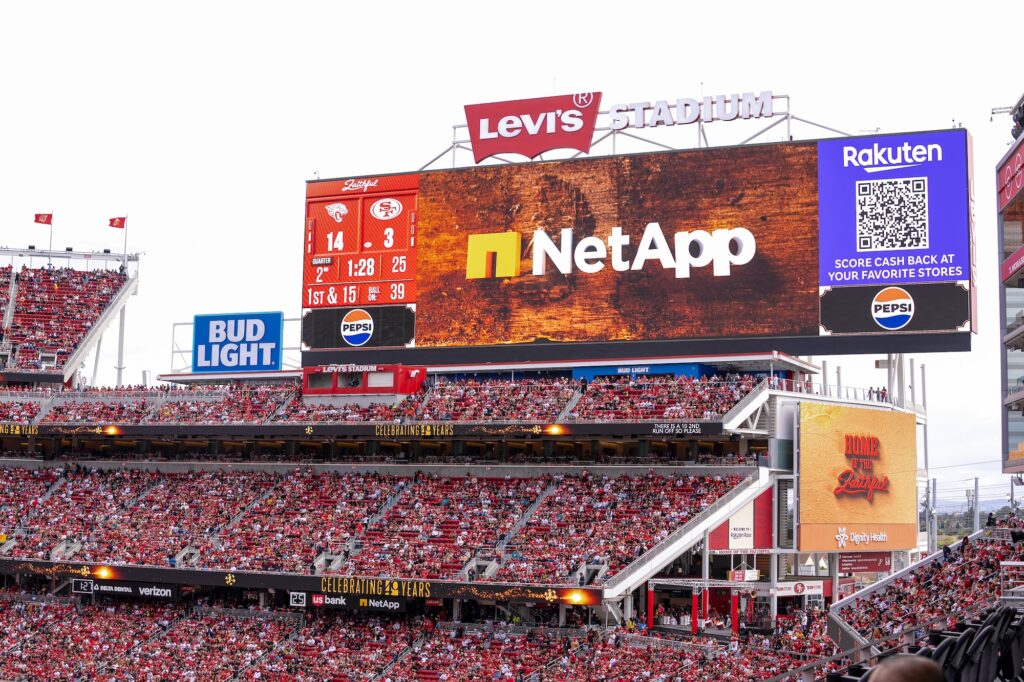
When NetApp pushed out an AI‑generated Super Bowl campaign in just two weeks at roughly one tenth the usual cost, it looked like a clear victory. The work shipped fast, hit one of the biggest stages in advertising and proved the creative team could move at AI speed.
Then it stalled.
Because the team had optimized so hard for speed and savings, they skipped some of the basics: structured testing, real optimization and a plan for what came after launch. The creative cut through quickly, but it didn’t have the staying power NetApp needed.
For Gabie Boko, CMO of NetApp, that failure was more important than the initial win. It forced her to reconsider how her team uses AI and what she actually expects it to change in marketing.
The lesson was not that AI creative is a dead end. It was that AI work still has to move through a full campaign lifecycle, with thoughtful planning, iteration and measurement, or the gains are shallow.
“That is when I stopped chasing AI for volume and started building it into the workflow as an orchestration layer instead, so my team spends less time on manual production and more time directing outcomes,” she said.
The team is also folding those lessons back into future work. “A single great moment without a follow‑up plan just is not a strategy,” she said.
These lessons also inform how NetApp uses AI more broadly.
From Content Volume to Orchestration
Most marketers feel the pressure to use AI to crank out more content. Boko has tried to push her team in a different direction.
“I am really looking at my role as maybe a business development and growth officer,” she said. “AI lets us orchestrate more of the work instead of just pumping out volume.”
She wants AI to act as an orchestration layer across the marketing stack, not just a production engine. Tools handle deeper analytics and pattern finding that would be slow or impossible with manual reports. The aim is faster, sharper reads on which accounts are engaging and how programs contribute to revenue and pipeline.
Instead of dictating a single toolkit, she focuses on the models and message discipline that sit underneath tools like Copilot, Claude or Jasper. “Everybody has their proclivity for tools,” she said. “I do not want to manage your tools; I want to manage the model so we are putting out content that is really meaningful.”
That shift has changed how people spend their time. Measurement is moving away from slow, backward‑looking reports and toward quicker funnel insight the team can act on. Rote production work is giving way to strategy and tighter coordination with sales and product.
Education and experimentation sit at the center of this change. Marketing is one of NetApp’s most active adopters of AI tools. Boko and her team have leaned into training, informal competitions around best use cases and an explicit expectation that everyone will help architect the AI strategy rather than wait for top‑down directives.
“We are really leaning on our people to experiment and ask, ‘If you could do something differently, what would it be?’” she said. “It cannot just be a passing fancy.”
Guardrails Against Hype and Hallucination
The Super Bowl experiment sharpened Boko’s view on AI hype as well.
The same technology that slashes production timelines can also encourage AI washing, where every campaign and feature gets stamped as AI without a clear benefit. At the same time, hallucinations and misinformation remain real risks, especially for a company that trades on data credibility.
NetApp’s answer has been to double down on data quality, model training and realistic guardrails. Internally, that means feeding AI tools with accurate, governed data and clear message maps so they reflect the company’s actual strategy rather than generic market language. It also means setting expectations that teams will measure AI‑driven work against real outcomes, not just novelty or speed.
Some lines, though, stay firmly on the human side. “Judgment on brand authenticity never leaves human hands,” she said. Deciding how fast to run after a trend versus when to pull back and make sure the story is genuinely NetApp’s, not just AI washing dressed up as innovation, is always a human call. Data integrity follows the same rule. Her team is accountable for training models on the right data and catching what AI gets wrong before it ever reaches a customer, especially given how much confidential data moves through their systems.
The bigger strategic questions also remain human decisions. Whether a large user conference still earns its place, whether a handful of the right customers in a room delivers more value or whether a fully agentic experience even needs a website at all, those are not choices she plans to optimize her way into. “Someone has to be willing to ask it directly and take ownership of the answer,” she said.
Boko also sees AI as different in scale but still subject to human governance. “I do believe AI is a millennium‑making piece of technology,” she said. “But I also believe in the human capacity to understand it, govern it and drive this change.”
Externally, she is careful about how NetApp shows up in AI conversations. The company talks about where AI improves security and agility rather than claiming to be an all‑purpose AI solution. The goal is to stay relevant to buyers who care about AI while avoiding claims the company cannot back up.
What Other CMOs Can Take From NetApp’s Shift
Boko is wary of handing out universal advice, but her own adjustments point to a practical path for CMOs trying to make AI feel less abstract and more operational.
Real experiments matter more than slideware. A high‑profile test like a Super Bowl spot reveals where process and measurement are fragile and creates space to reset expectations around testing, optimization and longevity for AI‑driven work.
Defining AI as orchestration rather than pure production also changes the conversation inside the marketing team. When AI is treated as connective tissue between data, tools and teams, it becomes easier to tie it directly to pipeline, revenue and customer experience. That, in turn, makes it easier to have grounded conversations with finance, sales and the rest of the C‑suite about what is working and what needs to change.
Boko is blunt that the CMO role is shifting as AI reshapes how marketing contributes to growth.
“The CMO role is absolutely changing, but it is not going away,” she said. “My job is in my own hands, and I want to be part of where this goes, not afraid of it.”