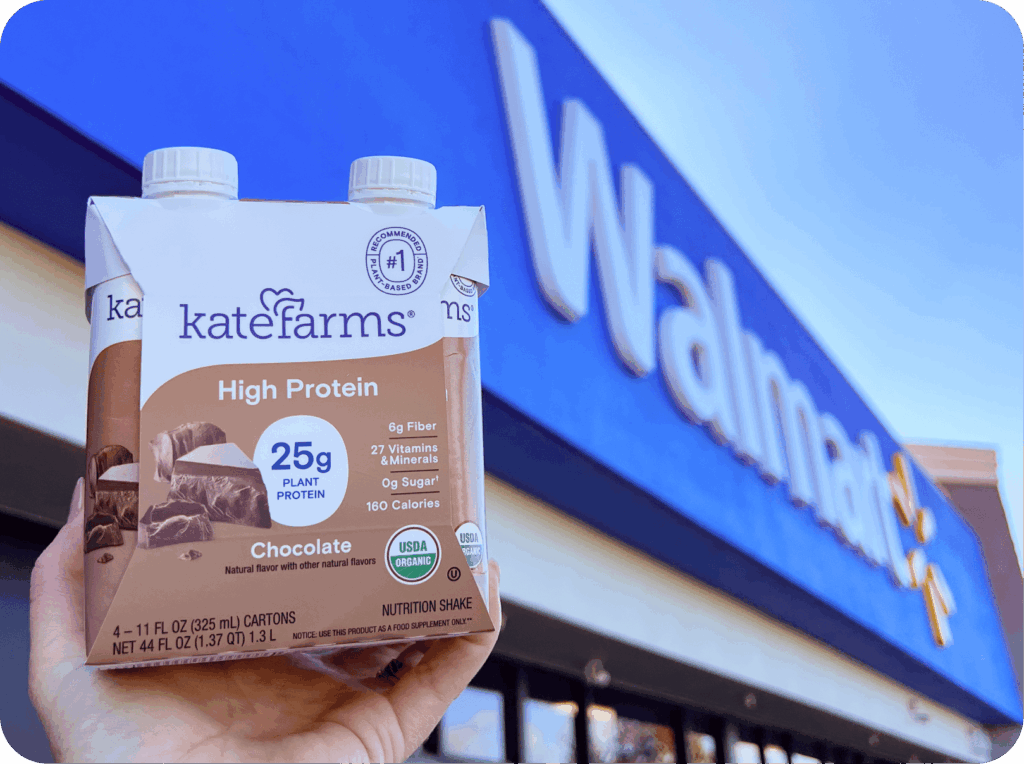
The medical-grade formula brand is marketing its products to consumers looking for extra nutrition, such as children and GLP-1 users. Kate Farms is increasing its investments in retail media networks and medical influencers.
Kate Farms is looking to 2026 as the year to substantially increase its brand awareness and acquire more everyday consumers.
The nutrition shake manufacturer quadrupled the size of its brand marketing team and is investing 30% more in advertising and promotions related to influencers, said Chief Marketing Officer Catherine Hayden.
“Our biggest opportunity for us is just broadening awareness,” Hayden said. “As we think about our marketing strategy and focus for us this year, it’s how do we let more people know about a great product that actually works, that supports health needs, that isn’t just puffery, that isn’t just storytelling or claims.”
Kate Farms Company Origin
Kate Farm debuted 13 years ago as a plant-based, allergen-free nutrition formula. The brand makes its products to be a sole source of nutrition, whether consumers are drinking it or getting it through a tube at a hospital. Today, the manufacturer has about 20% market share for medical-grade formula available in hospitals, Hayden said, with Abbott and Nestle as the main competitors. Kate Farms is available in 1,500 hospitals and most insurances cover the cost of it, she said.
From a revenue growth perspective, after the early years of 100% and 50% year-over-year revenue growth, its sales are now steadily growing 20% year over year in the medical channel and 50% on Amazon, Hadyen said. This is much better than channel averages, according to the marketing chief, as nutrition products in the medical channel are growing 4% year over year, and nutrition shakes on Amazon are growing 25% year over year, she said.
Now, Kate Farms is broadening its audience to focus on anyone who is looking for extra nutrition, such as children who have an allergy or are picky or an adult on a GLP-1 medication and now is on a restricted diet.
Kate Farms Builds a Loyal Customer Base
Kate Farms is relying on its history as a medical-grade formula to give itself credibility in the marketplace. For consumers who have a medical need, they may use the product for 18-24 months, or even a lifetime, Hayden said.
“Helping those individuals, even though it’s a smaller number from a scale perspective, it was a smart business decision in the beginning because you start to build that as your core and your base,” she said.
The more the brand can increase its awareness and get more shoppers to try its product, the more its sales will increase as it has a strong repeat purchase rate, Hayden said.
“We have almost a 70% repeat purchase rate, which is really significant,” Hayden said. “It’s working for people and they feel really good when they’re on it, and so they’re continuing. I would say the numbers are 10X that in the medical channel.”
Kate Farms Makes Retail Push
A large part of its brand awareness marketing push is more retail distribution. In March 2025 it launched its Kids Nutrition products in Target, and it debuted these products in Walmart in September. Plus, in November 2025, it launched its High Protein Nutrition Shake at Walmart.
These two products will be its focus for the year, and they seem to align with consumer trends, such as shoppers searching for high-protein products and looking for transparency in labels, Hayden said.
“Consumers are starting to question ‘better for you’ and what ‘better for you means,’” Hayden said. “They’re becoming more conscious about what they’re reading on labels to what information they’re getting from brands, which is great. As a nutrition company that is deeply committed to quality nutrition, I’m happy to see consumers doing that.”
Tactical Retail Marketing Strategy at Kate Farms
Now that Kate Farms has more retail distribution, it is increasing its ad spend on retailers’ retail media networks, such as Walmart Connect, to ensure its products are visible in search. It also has more incentives and coupons available in the cashback app Ibotta.
Hayden is looking into which websites consumers visits and where they convert — such as Katefarms.com, Amazon.com, Walmart or Target — when it has paid media, but it is too early to tell, she said.
“We’re now looking into partners that can help us identify where our working dollars, specifically for paid, is driving people,” she said. “We’re still a little bit too early in our brick-and-mortar channel expansion to understand those dynamics of preference of one over the other.”
In addition to these traditional tactics, Kate Farms is working with influencers and creators in this space, such as pediatricians and consumers who are on a GLP-1 medication.
“What would be different for Kate Farms than any other brand that might think they’re a better-for-you-brand is we will also be doing medical channel activation for kids nutrition specifically,” she said. And that entails “reaching 5,000 pediatricians, having a complimentary sales team in strategic states where we do have WIC [and] letting families know that this product is available to them.”
For its high-protein shake product, Kate Farms will be trying to work with pharmacies, dieticians and clinicians, to ensure they are educated about the product and can recommend it to their patients.
Retail Re-Entry
This retail push is actually a “re-entry” into stores as Kate Farms started selling outside of hospitals in 2015 at Katefarms.com, Amazon and a few brick-and-mortar natural grocery stores. After about two years it shuttered these channels. While its product had a good response from consumers and good sales growth, Kate Farms realized it didn’t have the right infrastructure to support the retail channel and its gross margin suffered.
After securing its foothold in the medical space, in 2023 Kate Farms began focusing on profitability, which it achieved in the second half of 2024, Hayden said. This helped to lead to July 2025, when global food and beverage company Danone acquired Kate Farms.
“We achieved profitability and now can make the right investment decisions on our own; it’s the right time for us to go back to retail,” Hayden said. “We’re much in a much better place set up for it infrastructure-wise, margin-wise, to now meet many more consumers.”