Few organizations are celebrating the New York Knicks’ presence in the NBA Finals as much as Blueair is. In March the company became the team’s Official Air Care Partner, with its air-wellness products installed throughout the Knicks’ training facility. Although there was no way of knowing that the team would end up in the Finals for the first time since 1999 — and become NBA champions for the first time since 1973 — Blueair felt their cultural prominence, along with the iconic status of their home arena, Madison Square Garden, made them an ideal representative.
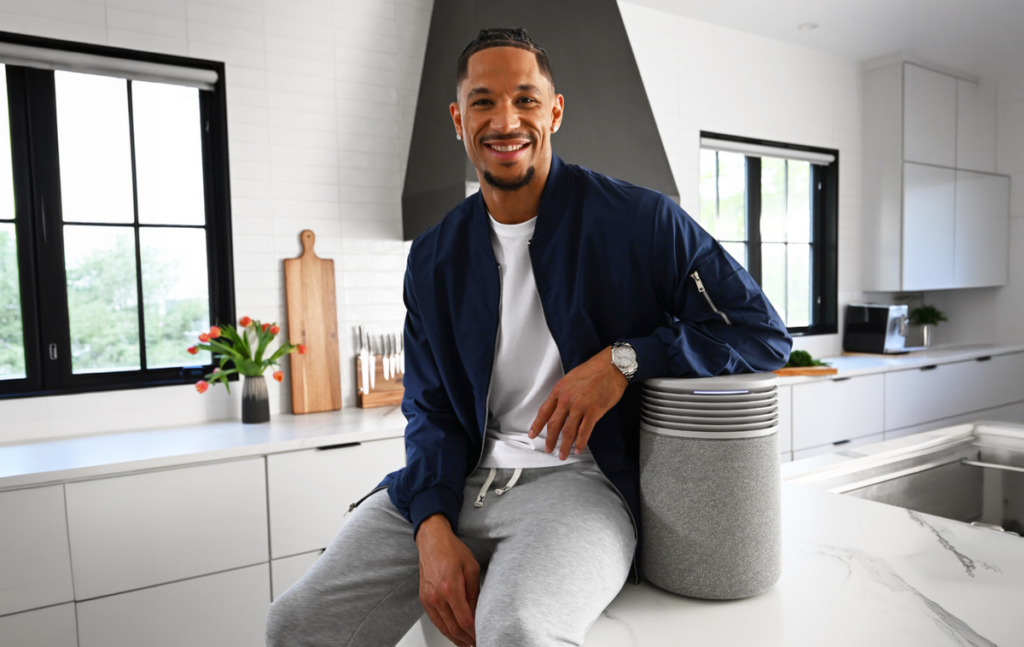
Shortly after the partnership’s opening tip-off, which included an activation at a Madison Square Garden suite with several players’ wives, the team representing Knicks guard Josh Hart reached out to work with the brand. The day before Game 1 of the Finals, Blueair debuted its partnership with Knicks guard Josh Hart, which shows him and his family using the company’s Signature Small purifier.
The partnerships with the Knicks and Hart followed Blueair’s first foray into sports marketing: its January collaboration with tennis champion Jessica Pegula. That partnership is continuing with activations for Wimbledon and the U.S. Open. “Jess gives us that authentic feel of one-on-one, of consumers feeling like they’re hearing the voice of a person who is an athlete they can trust because she wants to perform her best,” says Lara Kerbaj, Chief Marketing & Growth Officer at Blueair. “Then we wanted to look into a team sport because that’s where you can enter more into culture.”
Chief Marketer spoke with Kerbaj about what the sports partnerships say about Blueair’s evolution and the audiences the brand is wooing.
Chief Marketer: Why did Blueair decide athletes would be effective partners?
Lara Kerbaj, Chief Marketing & Growth Officer at Blueair: Over the past three years we’ve been transforming the brand from an air-purification brand into an air-wellness brand. As we worked on this journey it involved a couple of things. Obviously, most importantly, we are a product-centric company. So we had to expand our portfolio. We went from having only air purifiers to launching humidifiers, sleep alarm clocks, a two-in-one humidifier and purifier for your sleep … We’re creating this environment that doesn’t only purify the air around you but helps you optimize the air in your space for your best performance and best recovery.
As we aligned this portfolio in that direction and started looking at partnerships, I wanted to tap into something that is really genuine. People don’t think about air. People are talking about their sleep, their food, their water. Air is such an essential part of it. So for me, what was extremely important was to be able to tie this into something that is tangible. You’re not just getting any celebrity and sticking them on your brand and saying, “Oh, he or she likes this product.” It was tying this product into how they can perform better, and that’s how we came into sports.
Sleep and recovery are such an important part of athletes’ lives, and our air-wellness strategy is really built around sleep and comfort and how to optimize the air around you. We brought a sports consultant on board last year who helped us map it out, and then once you start reaching out to one team, all the teams want to talk to you: the NFL, NHL, NBA, tennis, Formula 1. We spoke to everyone and then came back with a strategy and funneled it down to a couple of directions.
CM: Would the Knicks campaign have looked different if the they hadn’t made the Finals?
Kerbaj: I don’t think so, because the thing about sports is your fan base is there and the link into sports and recovery and performance is there. You don’t need to invent it. I think as long as you find a tie-in to resonate the product with the athlete or the celebrity, then you’re good. If you win or lose, your story is your story.
CM: What channels and media are you using to promote these partnerships?
Kerbaj: We’re doing CTV for all of these campaigns. We have a big business on Amazon, so we do search and display on Amazon as well and organic and paid social. When we first launched the Knicks campaign, we also did out-of-home and we did some podcasts as well. So we’re really across all media, including YouTube, of course.
CM: How are you measuring the success of the programs?
Kerbaj: We have a long list of KPIs. From an organic social point of view we observe organic engagement likes, follows, how many people come into our accounts. Both the Knicks and Pegula have been extremely successful in terms of shares and likes and follows. Each campaign performs well in a different space. Again, I feel Pegula really speaks with authenticity because she’s this very determined woman who has a very strict routine to be able to perform how she performs. Then the Knicks are more sharable content, and people just are obsessed with them at the moment.
When it comes to CTV and the rest, we look at clickthrough rates. We look at ROAS, how many people are converting. A lot of these assets are linked into products as well. So we track how the sales are impacted. We saw an amazing lift in website traffic over the past six months, which is very, very promising. People are interested, people are coming and spending time on our website. We also look at how long people engage with the ads besides how many impressions that they’re getting.
CM: Is it safe to say that athletes are a substantial segment of the audience, and are there other segments you’re also actively courting?
Kerbaj: I wouldn’t say it’s only athletes that we’re targeting. I feel we are going to continue in the sports journey over the next couple of years. It’s working. And there’s different ways to do sports, right? Some athletes are more lifestyle driven, some athletes are more performance driven.
Actually, we’re using athletes to target everybody else, because it resonates with them. Our core consumers are health seekers: people in their 30s, 40s who have allergies, have pets, have kids, don’t sleep well at night and are looking for a solution to help them sleep better or live better. These are the easiest people to get into the category because these people know they have a problem and they want to improve their health.
Our second set of consumers is the wellness enthusiasts, and those are the ones we’re really homing in on in the past couple of years and what these partnerships are helping us grow into. It’s the people who constantly keep improving their lifestyle. They know these products exist, but they don’t know which brand to choose or why they need this, and they need more convincing. And that’s when I get endorsements from athletes and you say, “Listen, the Knicks are using it in their performance centers.” Then they’re like, “Oh, maybe if it helps legit athletes, it’s going to help me perform better and sleep better.” And that’s where we’ve seen really our audience grow over the last year.
Our third group of people is the health optimizers, and those are the ones who are a little bit more difficult to reach. Those are the ones who do ice baths every morning and are looking into biotech and they’re looking at the next technology. We have a portfolio that is more in that range, but we’re also looking at other partnerships, and we work with labs to validate how this impacts your sleep score and all of that.
This interview has been edited for length and clarity.