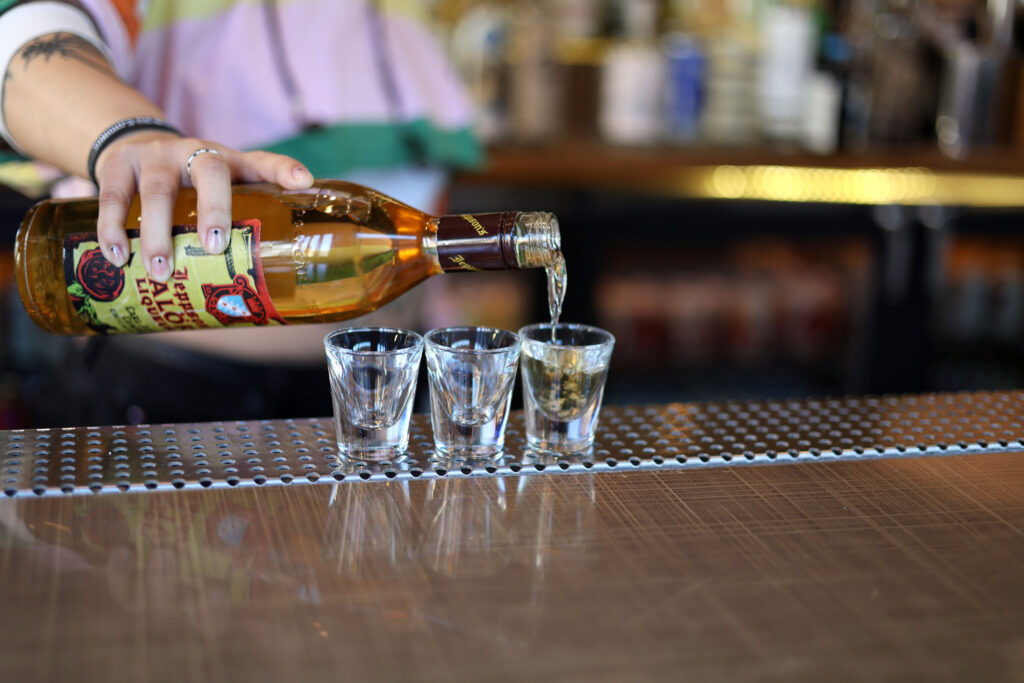
Sales for the alcoholic spirit known for its bad taste have quadrupled since 2018. The brand’s marketing hinges on consumers trying the shot with friends and sharing their experience.
Malört knows it has a reputation for tasting terrible.
Director of Marketing Anna Sokratov admits the alcoholic spirit has a unique taste. But the marketer thinks everyone should try it at least once. These are the pillars behind Malört’s most recent campaign: My First Malört.
The campaign centers on consumers telling the story about the first time they tried the beverage because it is so unforgettable. This is Malört’s biggest campaign yet in terms of scale, planning, number of assets, activations and account involvement.
“We’re really encouraging you to go out and do it, whether you might enjoy it or you might not,” Sokratov said.
The campaign might spur consumers to try the drink with friends, likely at a bar. This leads to more people drinking it and then wanting to share that experience too, she said.
“That’s part of what creates that repeat business for us, is that domino effect that happens where you want to share that experience,” Sokratov said.
Sales Rise at Malört
The brand’s ownership of its taste resonates with shoppers, as Malört sales have quadrupled since 2018, Sokratov said. This is also when CH Distillery acquired the spirit and has focused its resources on it, including expanding distribution, she said.
Malört, which has historically been popular only in Chicago and Midwest, has also steadily increased its distribution to now 39 states (including Washington, D.C.), up from fives states in 2018.
The sales increase even bucks recent trends of a decrease in alcohol consumption, especially among younger consumers. (Malört’s primary target consumer is males in their late 20s to late 30s, Sokratov said.)
“People are drinking less and less, but Malört sales are just continuing to rise every single year,” she said without revealing recent growth figures.
My First Malört
The brand’s current campaign relies on sexual innuendo to grab consumer attention with people talking about trying the drink without saying the word “Malört.”
“Something funny that we realized is when you talk about your first Malört experience and you take Malört out of the context of that, it tends to sound pretty sexual and dirty,” she said.
The brand will run this video on its social media channels, including Instagram and TikTok, plus it will work with influencers.
A main component to the campaign is the on-premise angle, which includes sending posters, table tents and stickers to bars. Bartenders provide a sticker to anyone who buys the drink with one of three phrases:
- My First Malört
- You Never Forget Your First Time (Drinking Malört.)
- Ask Me About My First Time Drinking Malört
The campaign also had an in-person event at infamous Chicago restaurant The Wiener’s Circle. The restaurant featured “Malört” on its marquee sign and had a combo menu item with Chicago classics including a shot of Malört, an Old Style beer and a mini hotdog. Consumers could also spin a wheel for a prize and receive a sticker.
“In some ways it will definitely transfer long-term into sales,” she said. “To have people try the drink for the first time is our biggest priority. We’re wanting people to come in and engage with the brand further than just taking the shot.”
Measuring Success
The brand will measure the campaign success based on how many bars participate in the program, sales and social media engagement.
Malört’s average social media engagement rate is about 10%-12%, meaning for every time a person saw a Malört post, they reacted, she said. The campaign goal is it to have similar engagement.
Overall, social media is the primary way it engages with its audience, which helps with the brand’s growth, she said. The brand frequently reposts consumers’ negative reaction to its drink, which is fine, as it makes Malört authentic, she said.
“We get a lot of videos sent to us and post online about people’s first time drinking Malört, and many people are gagging or maybe they’re saying that it was totally fine or something,” she said.
Comparison to Previous Campaigns
Malört will also analyze how the campaign performs compared to other similar initiatives in the past.
For example, in 2025 its “Malört Tastes Like” campaign allowed consumers to scan a QR code on a poster and submit what they think the drink taste like. It received a few thousand submissions —which was a good result for the brand — many of which were unflattering comparisons, such as gasoline and used bandages.
“We hear what people say about us and honestly we agree and we find it funny and we sort of use that perceived weakness as one of our biggest advantages here,” she said.
Another campaign during the 2024 election season had stickers that said “I Malörted,” riffing off the “I Voted” stickers on Election Day. Even though the campaign was only a few days, it received “a lot of engagement” with people posting pictures of themselves with the stickers, even now roughly two years later. What’s more, bars still ask for refills of these stickers, she said. This was the first time it had stickers associated with a campaign, and it proved that it drove engagement.
“The fact that it’s been able to continue on its own without us doing really anything at all except for maybe providing a few more stickers to other places over the years has been a really good identifier to us that it was something that was successful and that people wanted to engage with in person, which is the whole purpose of the program,” she said.