Marketers face the same dilemma every time a brand pops up in a social media trend. Jump in too fast, and you risk looking tone-deaf. Move too slowly, and the wave passes. Treat community creativity as free media, and you damage trust.
That tension is sharper for premium products with small budgets and long purchase cycles. A heritage pen brand cannot outspend mass CPG, and it cannot rely on impulse buys to smooth over missteps. The sequence began with an unsolicited Parker spec ad by Kushagra Oberoi. Andrew Tindall and Nick Entwistle of One Minute Briefs then launched an open “sell me this pen” challenge on LinkedIn. Newell joined after the challenge was gaining organic momentum.
While Newell is still measuring impact, CMO Nick Hammitt took us through a series of calls under time pressure — from whether to engage at all to where to run the resulting ads.
Decision 1: Whether to Engage at All
Although, Parker was not involved in the challenge, the team saw its products at the center of a growing thread.
“You’ve got to jump in on some of these opportunities when they arise,” said Hammitt. The team saw “this outpouring of creative expression coming from a tremendously wide scale of audience,” and by the end they had “submissions from around the globe, eight different countries.”
At first Parker treated it as social listening. As volume grew, the question became whether to leave it alone or fold it into an official program.
Hammitt said the team applied the same quick filter it uses for other cultural moments: relevance, brand fit and the ability to add something. “Any time an opportunity comes up, we quickly assess: okay, is it relevant? Is it something that makes sense for the brand? Is it something where we feel we can add something?” he said. “Because even if you hit those first two buckets, if you don’t feel like you can do anything that’s going to be creative to the conversation, you run the risk of actually dampening the impact versus kind of igniting and growing it.”
In this case, the content was already about Parker and its core product. It also lined up with how the brand positions itself. Parker’s “Write your way” platform links fine writing tools to individual expression, and Hammitt said watching creators pitch the pen in their own voice on brand and “for the moment.”
The unresolved piece was whether formal involvement would help or hurt. “We just thought this was a great opportunity to get involved authentically,” he said, “because you want to make sure that you’re not just coming in and trying to overbrand it and turn it into just a sell moment, but rather use this as an opportunity to celebrate the creative community that honestly is a backbone of many of our writing brands, Parker included.”
On that basis, Newell chose to participate. The decision at that stage was directional. The company did not yet know what the final outputs would look like or what they would deliver.
Decision 2: How to Pick Winners Quickly and Pay for the Work
By the time Parker became involved, Andrew Tindall and Nick Entwistle of One Minute Briefs had launched the challenge and initiated consumer testing with System1. The challenge drew about 350 submissions. Eight countries were represented among the top 10 entries, which System1 tested with thousands of consumers.
For Newell, the decision was how to support the work as the challenge gained momentum. Hammitt said speed mattered: “You don’t want to miss your moment. If you drag this out and go through a big testing process, the moment’s going to pass. Consumers move on, culture moves on, and you’re going to miss your ability to engage when it’s relevant and top of mind.”
Newell chose to support the top 10. “We loved so many of these entries that we wanted to support the top 10,” Hammitt said. “In a perfect world, we would support all of them, but you just kind of start to run out of money on what you can kind of impact.”
The company contacted the creators to explain the plan and secure buy-in. Hammitt said Newell told them, “We’d love to be able to feature you, we want to pay you for your content, we’re going to put support behind it.” The company did not share payment terms or media spend.
Decision 3: Where to Run the Ads
The next question was where to run the selected ads so they had a chance to perform.
When brands think about video-driven community content, platforms like TikTok and YouTube Shorts are usually the first stop. LinkedIn has historically skewed more toward B2B and recruiting, with higher media costs than some consumer channels. “When you go about advertising your brand or anything else like that, LinkedIn isn’t usually the first place you go to,” Hammitt said. “You’re mostly in the TikTok space, your YouTube Shorts, all of those other things.”
In this case, Parker kept the work where it started. The team leaned into LinkedIn’s professional audience on the theory that it overlaps with people willing to spend more on tools they use every day, including what Hammitt described as “a high-end pen.” For a fine writing brand that is not an everyday mainstream product, that is a hypothesis rather than a proven rule.
“We’re now learning what engagement looks like through that channel,” Hammitt said. The team is tracking what happens inside LinkedIn and also whether the work affects how people think about the brand or brings Parker into consideration for people who did not have it on their list. Newell has not yet shared specific lifts in awareness, favorability or sales tied to the campaign.
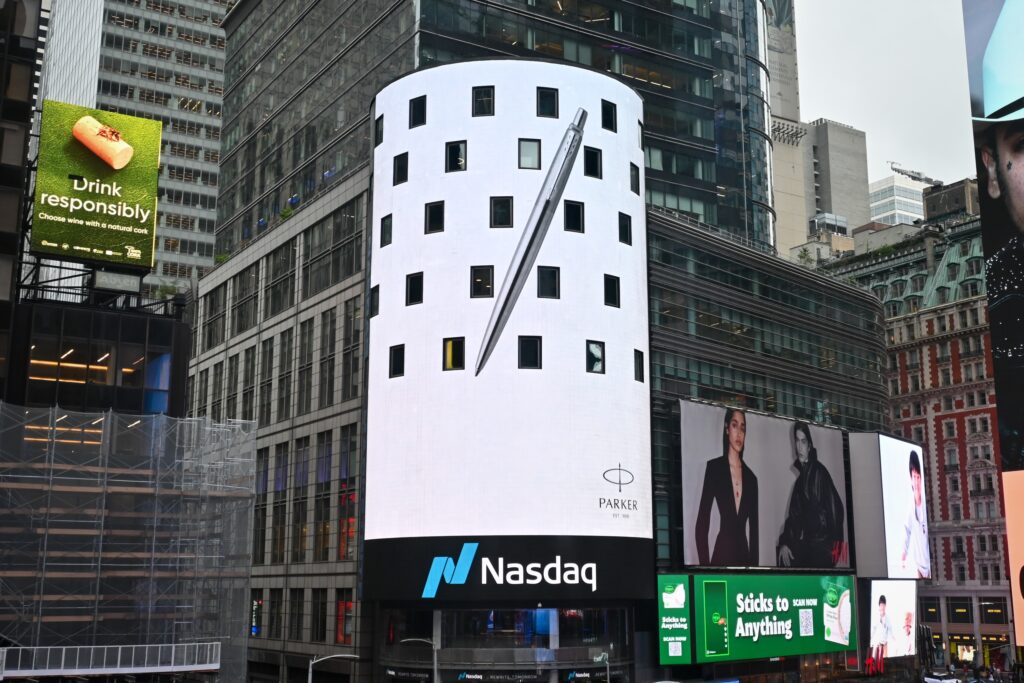
The company also chose a more traditional channel: digital-out-of-home in Times Square. Newell used billboards there to showcase the winning ads and the artists behind them. Hammitt said the move was partly “a celebration of the artists themselves” and partly a way to “make that splash as big as we can” for what he called “a moment in time” under budgetary restraints.
Lessons for Marketers
For brands that find themselves in a similar situation, Hammitt’s advice centers on what a brand brings to an existing conversation. “What you need to always keep in mind is what you are bringing to the table as a brand,” he said. “Why is anybody going to care, and why is it going to be authentic and credible?”
He also warns against forcing a fit. “If you just go in there and either try to push an agenda that wasn’t part of the conversation, or you go in there and you just start slapping your logo all over the place, you’re going to seem tone-deaf and out of sync,” he said. “You’ll actually squash the moment versus amplify the moment.”