
The average U.S. household is expected to increase its holiday spend by 4% over last year, to $1,654, according to new research from consulting firm Deloitte.
This is in line with Deloitte’s overall holiday forecast, which projects total retail sales from November 2026 through January 2027 to increase between 4.0% and 4.8% and reach between $1.70 trillion and $1.71 trillion. Within this figure are online sales, which Deloitte expects to increase between 7.5% and 8.4% year over year.
For the first time, Gen Z and millennial shoppers will account for 50% of holiday spending, according to Deloitte’s forecast. These younger shoppers are driving the holiday sales increase, with both groups planning to increase holiday spending by double digits. Both groups say their household financial situation is better this year compared with last year, Brian McCarthy, Retail Strategy Leader at Deloitte, said in an email.
Retailers should cater to these younger shoppers’ interests in personalization and convenience by providing wish-list tools, fast delivery and gifts that can be personalized, McCarthy said.
The share of expected holiday spending, by generation, is:
- Gen Z (18-29 years) — 16% of spend, up from 10% in 2025
- Millennials (30-45 years) — 34% of spend, up from 31%
- Gen X (46-61 years) — 28%, down from 31%
- Baby boomers (62-80 years) — 20%, down from 26%
The $1,654 household spend breaks down into $988 in planned spending on retail goods, a 10% year-over-year increase, and $666 on holiday activities, a 4% year-over-year decrease. Shoppers cite higher prices than last year as a main reason why they will increase their spend on goods.
Deloitte’s consumer data is based on a survey of 4,000 U.S. adults, representative of the U.S. population, conducted Aug. 26 to Sept. 10.
Beyond younger shoppers driving holiday spending, the themes of the 2026 holiday shopping season are ones that have shaped retail over the past few years: Consumers seek value, and they will shop early to get it.
Shoppers Who Use Tech Tools Spend More During the Holidays
For younger shoppers, generative AI is a primary shopping tool, the survey finds. Overall, 39% of consumers say they use generative AI for budgeting, gift inspiration, deal discovery, personalized recommendations, price comparison or finding alternatives. This bumps up to 49% for Gen Z shoppers and 50% for millennials.
Shoppers who use technology tools — generative AI, search and social media — spend more on average than shoppers who don’t. In fact, the more tools shoppers use, the more they spend on average. Deloitte finds:
- 30% of shoppers plan to use all three tech tools and plan to spend $2,893 on average for the holidays.
- 35% of shoppers plan to use two tech tools and plan to spend $1,436 for the holidays.
- 27% of shoppers plan to use one tech tool and plan to spend $1,222 for the holidays.
- 8% of shoppers don’t plan to use any tech tools and plan to spend $1,147.
Early Shopping and Holiday Value Seekers
As far as early shoppers go, more than 1 in 5 shoppers (22%) plan to start shopping earlier this year compared with last year. What’s more, 28% of shoppers say their budget is “likely to be exhausted” by the end of October. This is the highest share in Deloitte’s survey in six years.
Promotions are helping drive shoppers to buy early, with 42% of shoppers saying they plan to shop during October sales, which is nearly as many as the 44% of shoppers who say they will buy on Cyber Monday.
November is the largest expected holiday shopping period.
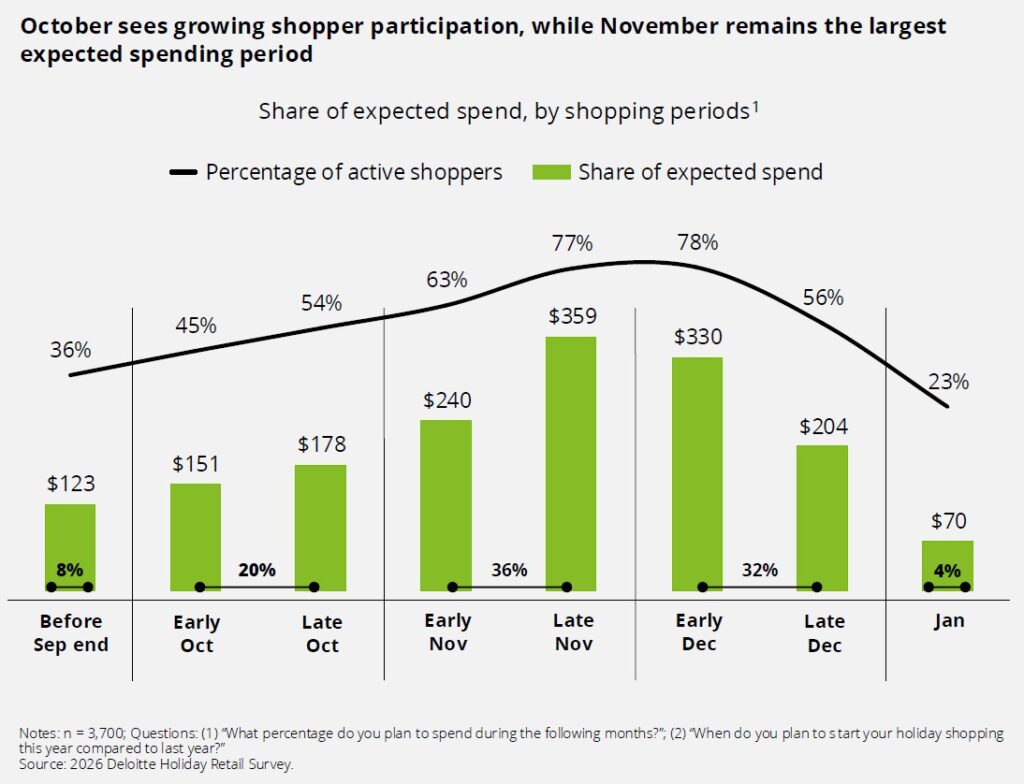
This early shopping is one of the attributes of what Deloitte calls a “holiday value seeker.” Deloitte says about 38% of consumers are holiday value seekers. These holiday shoppers:
- Start early (65% of holiday value seekers will have started shopping by late October compared with 48% on average) and stay engaged all season long.
- Are savvy about how and where to buy, redeeming loyalty points and buying private labels.
- Shop at off-price retailers and dollar stores.
- Visit retailers on social media and use generative AI.
Holiday value seekers also plan to spend 12% more than the average shopper. This is because consumers define value as more than just price, McCarthy said.
“Additional factors driving value can include product quality and trust in the brand,” McCarthy said in an email.
The Deloitte 2026 Holiday Retail Survey also found:
- Half of shoppers plan to give experiences as gifts this year, up from 47% in 2025 and 39% in 2024.
- Clothes and accessories is the largest shopping category, with 67% of shoppers planning to buy in this category, followed by toys and hobbies at 61%.
- Shoppers plan to spend more on gifts and seasonal items this year and decrease their spending on travel and events.
- 33% of shoppers plan to buy a gift for themselves during the holidays, led by Gen Z (49%) and millennials (42%).
- Shoppers plan to buy an average of eight gifts, the same as last year.