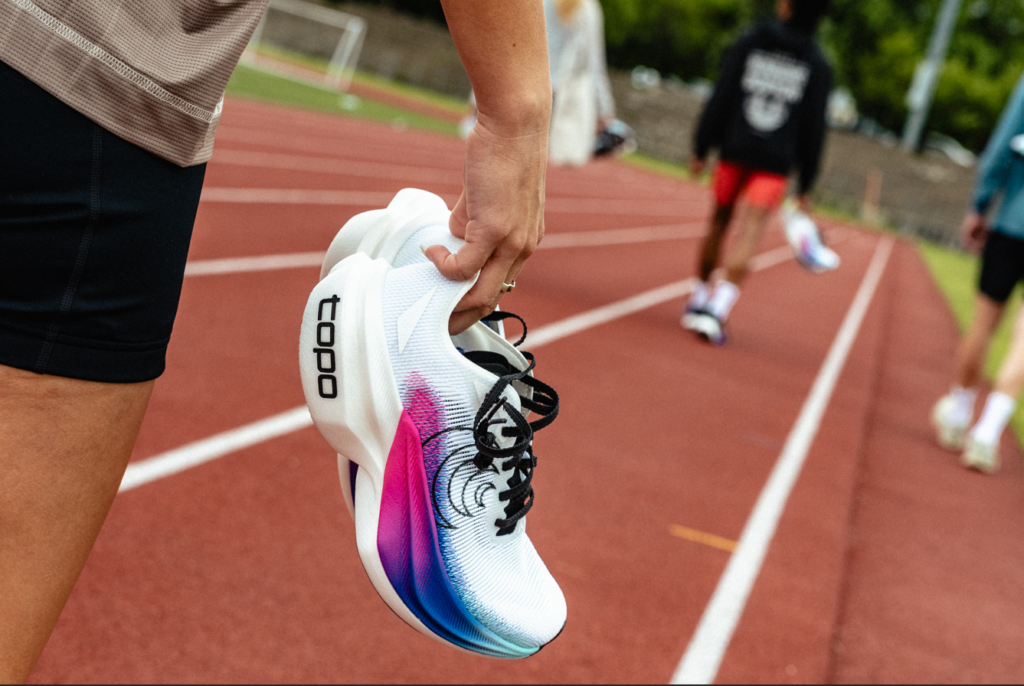
As retailers chase direct-to-consumer sales, Topo stays loyal to specialty retail, even four years after the Designer Brands acquisition.
Topo Athletic’s newest shoe launch sold out within an hour online. This shoe drop was the exclamation point on the shoe brand’s most coordinated marketing effort to date for its new Pro Series line, said Christina Enochs, Senior Brand and Creative Manager.
The Pro Series is the brand’s new shoe line that it launched in August. To build excitement, the product line has its own branding, logo, product box, messaging and vibe that is distinct from the rest of the brand. Prior to the drop, the website flipped to this branding scheme and had a countdown until the launch.
Topo is a 13-year-old brand that focuses on performance running shoes for serious runners. The new product has a carbon-plated race shoe dubbed the Specter Elite. The brand’s competitors have had shoes with this technology for years, but this is the first time Topo has used this material, which aids in the speed of the shoe.
The brand combines the carbon plate with other unique Topo fit features, including a roomy toe box, a low drop and a lightweight, responsive foam in the midsole. All these elements provide runners with faster speed, Enochs said.
Launching Shoes as a ‘Drop’
Topo Athletic decided to do a drop release of this product line as the brand aims to attract younger consumers who are used to consuming marketing, information and social media content in a similar way, in that something is here and then you move on quickly, Enochs said.
“We wanted to pull in a more modern running customer,” Enochs said. “Across the board, especially in the 18 to 25 age range, that drop mentality and that drop way of marketing things is what’s happening.”
Unlike some shoe brands, which release a shoe that sells out and then is gone, Topo is planning several restocks of the shoes.
While a drop release is a buzzy marketing tactic, it’s also a practical one for the brand as it doesn’t have the budget to go deep on inventory. Topo would not reveal how many pairs of shoes it purchased but said that the bulk of the small release went to its retail stores and the rest went online.
“We’ve been around for a while now, but we’re not like the Hokas of the world right now where we just have an endless budget to just make everything we want,” Enochs said. “It is a balancing act of what can we do with our bandwidth right now and making sure that we’re providing to the customer.”
Retail Stores Are a Core Pillar For Topo
Selling product at specialty running stores is a “core pillar” of its company as it builds strong relationships with the sellers who are talking directly to potential customers, said Carolyn Clarke, Public Relations Specialist for the brand.
Plus, Topo’s fit is its product differentiator. When a shopper tries the shoe on at a store, it greatly increases the chance of conversion, Enochs said.
“You’re looking at it just on our website and you’re like, ‘Roomy toe box? I don’t have a wide foot. Low drop? I don’t really get what that means,’” Enochs said. “But if you go in store and you put it on, you’re like, ‘This feels great.’ And the barrier to entry kind of breaks down there.”
Enochs also credits Topo’s customer service team of seven in-house employees as “the best in the industry.” These employees help both web and retail customers.
Topo Aims To Build Strong Relationships With Specialty Running Stores
By prioritizing stores, Topo aims to build strong relations with those retailers and educate them on its products. If those stores understand its products, they can talk about them knowledgeably to shoppers and point out the differences. This is key for a shopper who may have never heard of the brand and is discovering it in-store for the first time.
This strategy is a departure from what many legacy brands are focusing on now and how brands launch today, which is a focus on direct-to-consumer sales.
“In this landscape, everyone thinks D2C is what everyone’s doing. But for us, from the start, it’s always been about supporting run specialty,” Enochs said. “It’s been about keeping it in stores and prioritizing that channel first — sometimes at the expense of our web customer. But in the long run, it’s benefited us and it will continue to benefit us to keep that as our main priority.”
For example, Topo Athletic will restock inventory at retail stores that are out of a product at the expense of its own website, she said.
“I can’t see a downfall to that when you’re in this industry and you need to be in those doors in order to make it as a company,” Enochs said. “It’s built strong relationships where they trust us, they know that we’re going to follow through on the things that we say. They know that we’re going to prioritize them and it helps their business.”
Topo Athletic Stays the Same Post-Acquisition
Designer Brands (owner of DSW retail stores and other shoe brands) acquired Topo Athletic in 2022.
Even after four years under Designer Brands’ ownership, not much has changed, and that’s a good thing, Enochs said.
“They didn’t come in and put their hands in everything and that’s actually been great because it’s allowed us to just progress at the level that we’ve had,” she said. “It’s been a slower changeover to some of their resources.”
Slow to change means that the brand is still holding onto its identity, but it does not have access to more resources that are often associated with large brands. For example, Topo Athletic only has 31 total employees, six of whom are marketing employees. The brand doesn’t operate any of its own stores and it doesn’t have an unlimited budget to go deep on inventory for new products like this one.
But the Topo Athletic brand likes to keep its distribution tight and market itself as a premium product, which still occurs today. For example, Topo rarely, if ever, discounts its products, which is why it hasn’t sold at DSW and still doesn’t sell there today despite both brands having the same parent company.